This glossary explains the words researchers use about interviews and customer calls in plain English, with short examples. Use it whenever a guide or a report uses a term you don't recognize.
A
Anchoring
Tying a conversation to a specific recent moment. Example: "Think about the last time you did this."
B
Bias
A tendency that pushes results in a particular direction. In interviews, it usually means your own expectations shaping the answers.
C
Closed question
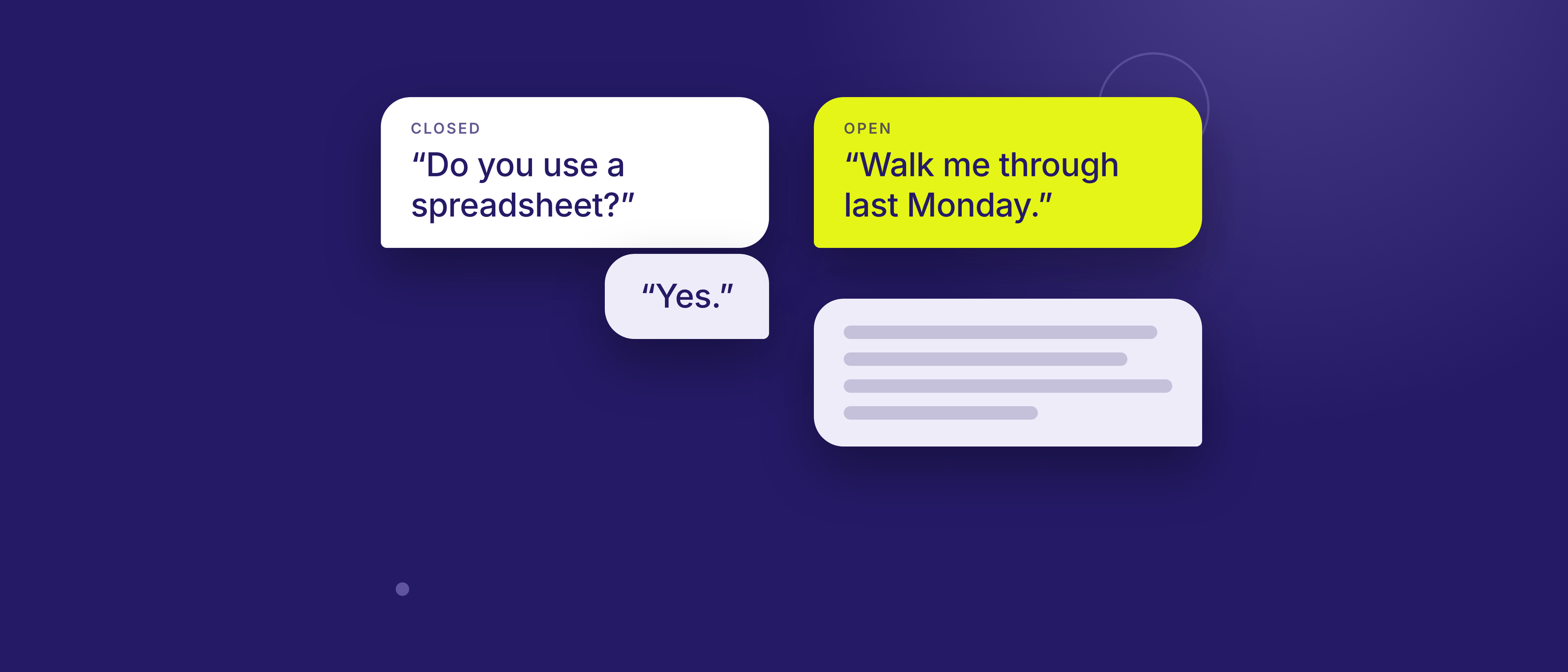
A question answered with yes, no, or a short fact. Example: "Did you use it last week?" Useful for confirming facts.
Comprehension
Whether someone understands what a concept is and does, in their own words. Checked separately from whether they like it.
Concept testing
Showing people an early idea (a sketch, description, or prototype) to learn whether they understand it and whether it fits their real life.
Confirmation bias
Noticing and remembering what agrees with your idea, and overlooking what doesn't.
D
Discovery call
A conversation with a customer or potential customer to learn about their needs, problems, and how they work today, before you decide what to build or sell. The goal is to learn, not to pitch.
Double-barreled question
Two questions in one, so you can't tell which one they answered. Example: "Is it fast and easy to use?"
F
Focus group
A moderated discussion with a small group of people about a topic, product, or idea.
Follow-up question
A question you ask in response to what someone just said. Most of the learning in an interview comes from these.
Friction
Any place where someone hesitates, gets confused, makes a mistake, or has to work around something.
G
Generalization
A broad statement such as "I always..." or "Most people...". Ask for a specific example to test it.
L
Leading question
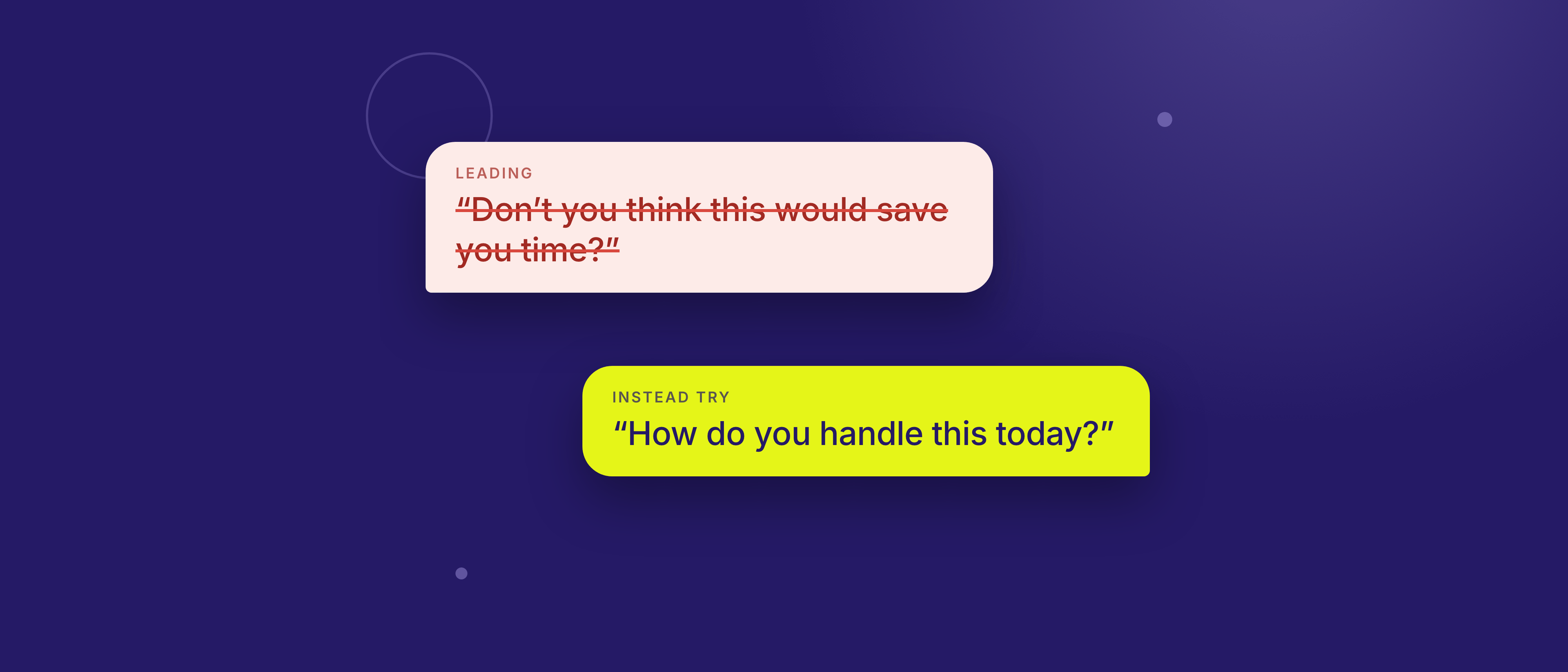
A question that hints at the answer you want. Example: "Wouldn't it be great if this were faster?" It pushes people to agree rather than share what's true for them.
M
Moderator (or facilitator)
The person running the session. Their job is to guide the conversation without steering the answers.
O
Open-ended question
A question that can't be answered with one word and invites a story or explanation. Example: "How do you handle this today?"
P
Pain point
A specific frustration, delay, or cost someone experiences while getting something done.
Participant
The person you're interviewing or testing with. Also called an interviewee or respondent.
Pilot
A practice run of your session with a colleague, to catch problems before the real ones.
Probing
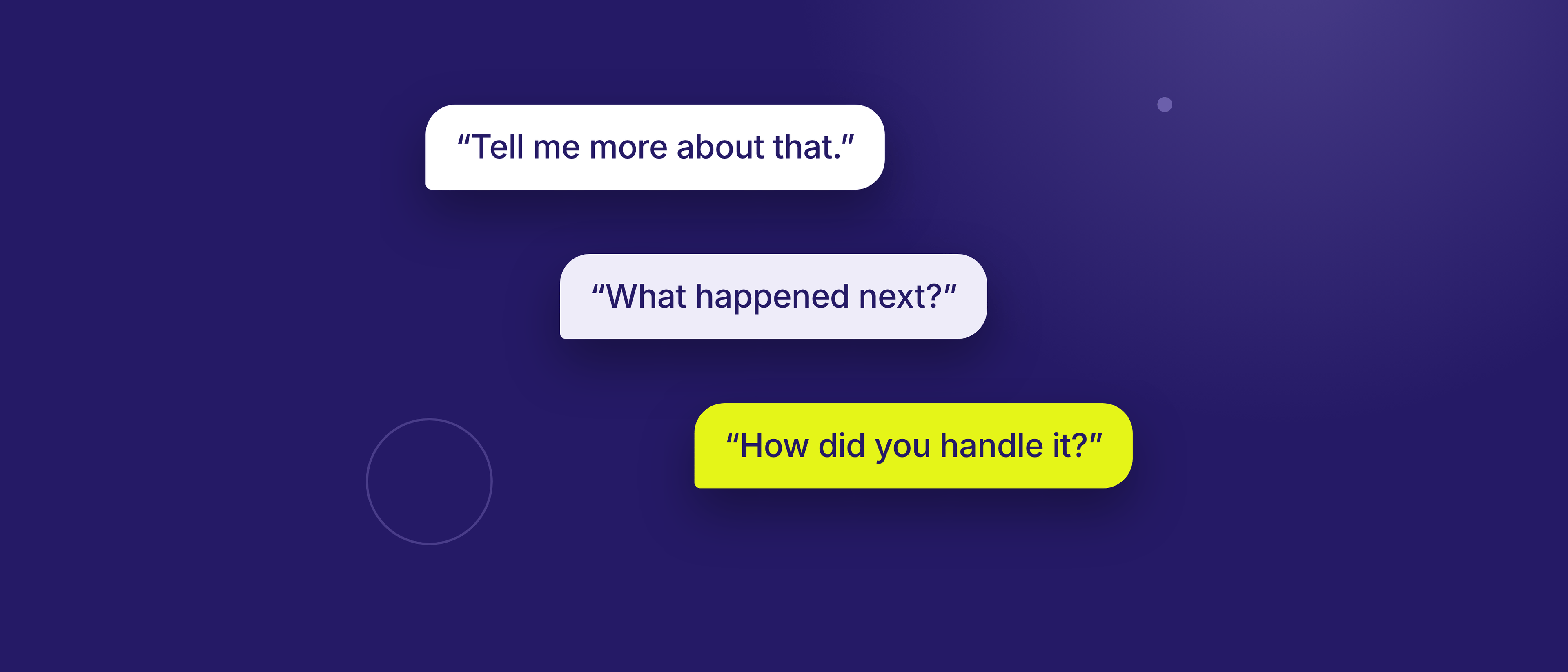
Asking follow-up questions to go deeper into an answer instead of moving to the next prepared question. Example: "Tell me more about that."
R
Rapport
The comfort and trust between you and the participant. When it's good, people share more openly.
S
Screener
A short set of questions used to check that someone fits the group you want to talk to.
Severity (High / Medium / Low)
How serious a problem is. High changed what you learned or blocked the person; Medium weakened the result; Low is polish.
Social desirability bias
People's habit of giving answers that make them look good or please you, instead of the plain truth.
Specific example (or episode)
A concrete moment from the past, such as "last Tuesday, when I...". Stories like these are more reliable than general statements like "I usually...".
Synthesis
Combining what you heard across several conversations into patterns and takeaways.
T
Talk ratio
How much of a conversation is you versus the participant. In discovery calls, the participant should do most of the talking.
Think-aloud
Asking someone to say out loud what they're looking at, thinking, and expecting while they use something. It lets you see their reasoning, not just their actions.
U
Unprimed reaction
Someone's first honest response to something, before you've explained it or told them what to think.
Usability test (or usability session)
A session where you watch someone try to complete realistic tasks with a product to find where they struggle and why.
W
Workaround
A makeshift way someone gets something done because the proper way doesn't work well. Workarounds are strong evidence of real needs.
Check your own calls
Reports are easier to use when you know what the words mean. Try Verafair and every term in your report is explained in plain language, with your own examples.
Frequently asked questions
What is the difference between an interview and a discovery call? They're very similar. A discovery call is a type of interview focused on learning about a customer's needs and situation before you build or sell something.
Do I need to learn all these terms? No. Start with open-ended question, leading question, and probing. Those three cover most of what matters.
What does "unprimed" mean? It means before you've told the person anything that could shape their reaction.
What does "probing" mean? Asking follow-up questions to go deeper into what someone said.
Why do researchers avoid "why" questions? Because "Why did you do that?" can sound like a judgment. "What led to that?" usually gets a more open answer.