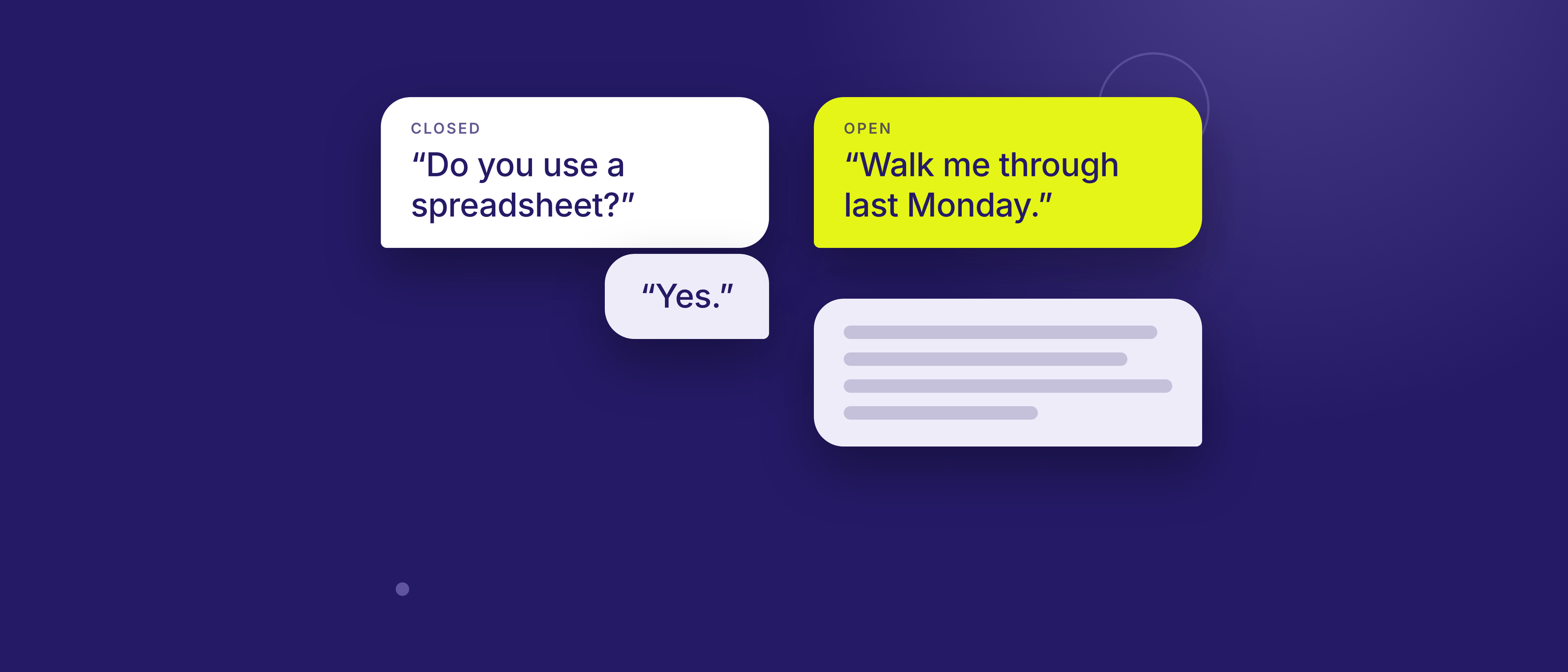
An open-ended question is one that can’t be answered with a single word, such as “Tell me about the last time you…” or “How do you decide…?” It invites a story, an explanation or an opinion in the person’s own words. A closed question can be answered with “yes,” “no,” or a short fact, such as “Do you use a spreadsheet for this?” Open questions show you how people think and act; closed questions confirm details you already know to ask about.
Neither is good or bad. They do different jobs, and the trouble starts when you use one for the other’s job.
30+ open-ended question examples, by situation
The open-ended questions below are grouped by what you’re trying to learn in a customer or user interview. Swap the bracketed words for your own topic.
Warming up and getting context
- Can you tell me a bit about your role and what a typical week looks like?
- What are you responsible for that’s most on your mind right now?
- What does a good day look like for you, compared with a bad one?
How the work really happens
- Walk me through how you [do the task] from start to finish.
- What’s the first thing you do when [the trigger happens]?
- What tools or documents do you use along the way?
- Where does most of the time go?
A specific past moment
- Tell me about the last time you [did the task].
- What led up to it? What was going on that day?
- What happened next?
- Looking back, what would you change?
Questions about a specific past moment tend to be the most reliable. Teresa Torres notes that “humans are bad at accurately answering direct questions out of context,” so she asks for a specific story instead (Product Talk, “What Are the Best Customer Interview Questions?”, 2022).
Problems and workarounds
- What’s the hardest part of [the task]? Can you give me an example?
- Have you found any workarounds? Tell me how they work.
- What happens when this goes wrong, and who feels it?
Decisions
- How did you choose the tool or approach you use today?
- What else did you consider?
- What triggered you to change how you do this?
Usability sessions (think-aloud)
- What are you thinking right now?
- What did you expect to happen there?
- What would you do next?
Concept and idea reactions
- What do you see here, and what do you think it’s for?
- What, if anything, stands out to you in a positive way?
- What, if anything, feels like it might not work for you?
Focus groups
- Has anyone had a different experience?
- What would you add to what we’ve heard so far?
Follow-ups that keep a question open
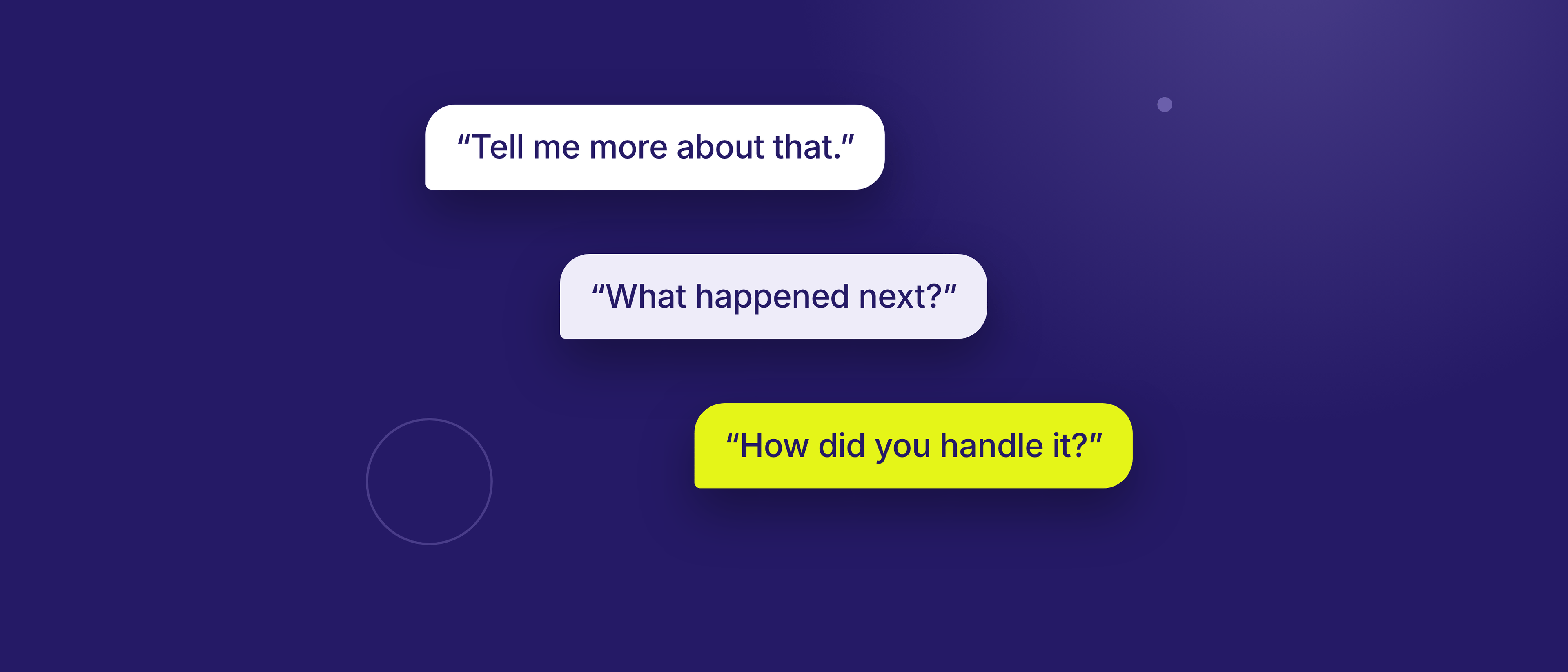
- Tell me more about that.
- What happened next?
- Can you say a bit more?
- What do you mean by [their word]?
Wrapping up
- What should I have asked that I didn’t?
- Is there anything that surprised you or that we didn’t cover?
Notice the pattern: almost every one starts with Tell me, Walk me through, What, or How, never “Do you,” “Is it,” or “Would you,” which are the closed-question starters below.
Open-ended question examples for work, school and surveys
The same rule works outside interviews: ask about a real experience, and start with “what,” “how” or “tell me about.”
One-to-ones and team meetings
- What’s been taking up most of your time this week?
- What got in the way on the last project?
Classroom discussions
- How did you work out that answer?
- What do you think the character wanted in that scene?
Customer feedback surveys
- What almost stopped you from signing up?
- What’s the one thing you’d change about [the product]?
- What were you trying to do when you ran into the problem?
What’s the difference between open-ended and closed questions?
The difference is the answer format: an open-ended question lets the person answer in their own words, while a closed question limits the answer to yes or no, a short fact, or a set of options you supply. Nielsen Norman Group sums up the trade-off: “Open-ended questions result in deeper insights. Closed questions provide clarification and detail, but no unexpected insights” (NN/g, “Open-Ended vs. Closed Questions in User Research”, 2024).
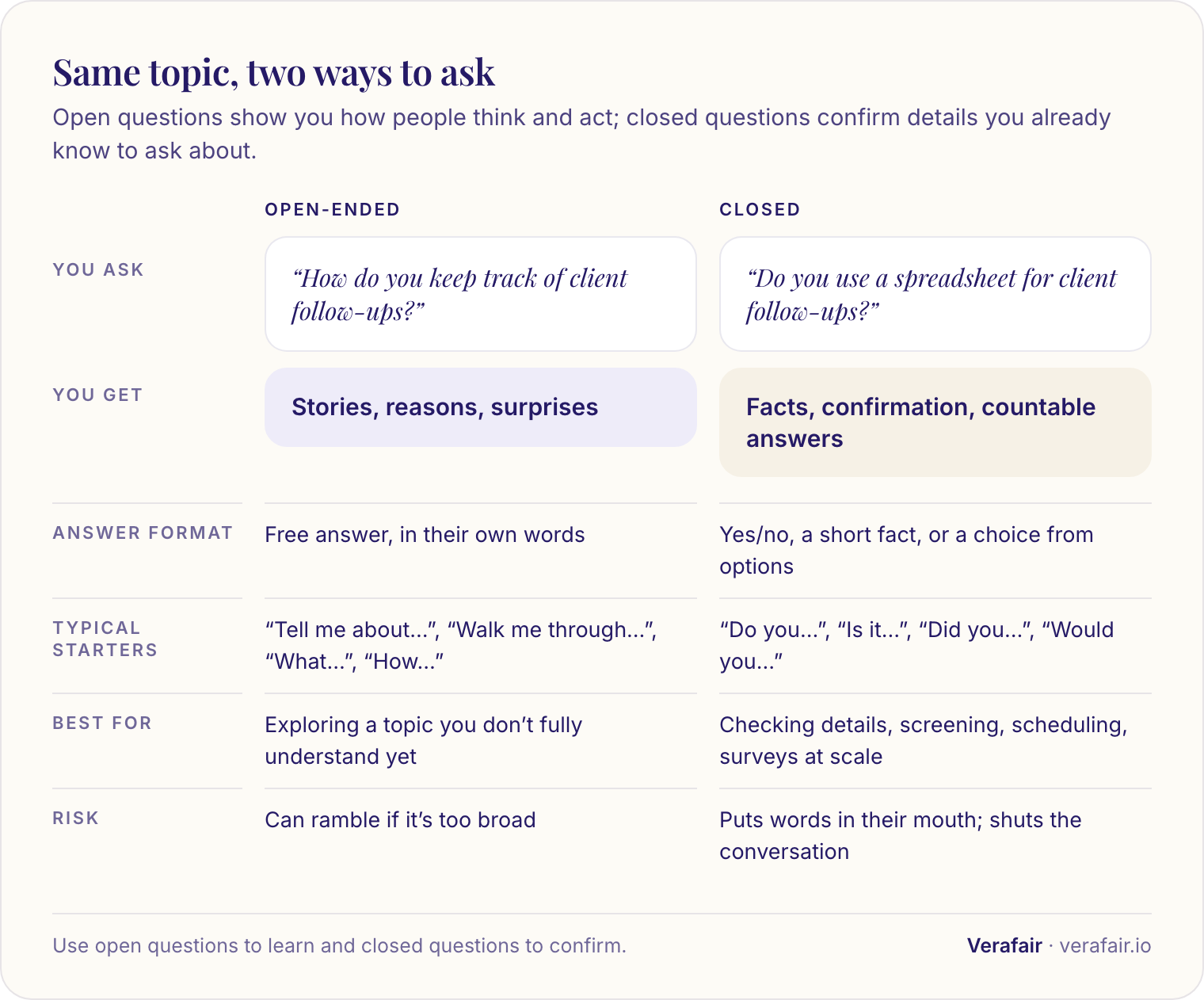
| Open-ended | Closed | |
|---|---|---|
| Answer format | Free answer, in their own words | Yes/no, a short fact, or a choice from options |
| What it gets you | Stories, reasons, surprises | Facts, confirmation, countable answers |
| Typical starters | “Tell me about…”, “Walk me through…”, “What…”, “How…” | “Do you…”, “Is it…”, “Did you…”, “Would you…” |
| Example | “How do you keep track of client follow-ups?” | “Do you use a spreadsheet for client follow-ups?” |
| Best for | Exploring a topic you don’t fully understand yet | Checking details, screening, scheduling, surveys at scale |
| Risk | Can ramble if it’s too broad | Puts words in their mouth; shuts the conversation |
Why the format changes the answer
Offering options changes what people say. In a 2008 Pew Research Center post-election survey, 58% chose “the economy” as their most important issue from a list of five, but only 35% volunteered it when the question was open-ended, and 43% of that group named something not on the list at all (Pew Research Center, “Writing Survey Questions”). A closed question can only find the answers you already thought of.
Types of closed questions
Closed questions come in a few common forms. In an interview, use them after an open question to pin down a detail; in a survey, they’re the backbone because they’re quick to answer and easy to count.
- Yes/no: “Did you use it last week?”
- Short fact: “How many people are on your team?”
- Multiple choice: “Which of these tools do you use: A, B or C?”
- Rating scale: “On a scale of 1 to 5, how easy was that?”
- Ranking: “Put these four features in order of importance.”
When should you use open or closed questions?
Use open questions to learn and closed questions to confirm.
Use open questions to learn. At the start of a topic, when you don’t yet know what matters, and whenever you want to hear something you haven’t thought of.
Use closed questions to confirm. After you’ve heard a story, to check a fact: “So that was in March?” or “Did you do that on your own?” They’re also useful for practical matters: scheduling, permission to record, screening questions.
A good pattern is open first, then closed to check. For example:
- Open: “Tell me about the last time you had to pick a supplier.”
- Closed (to confirm): “And that was for the whole team, not just you?”
What about surveys?
In a survey, keep open-ended questions few, because people skip them far more often: on Pew Research Center’s American Trends Panel, closed questions average 1–2% nonresponse, while open-ended questions average around 18% and range from 3% to just over 50% (Pew Research Center, “Why do some open-ended survey questions result in higher item nonresponse rates than others?”, 2021).
How do you turn a closed question into an open one?
Most of the time, you only need to change the first word and ask about their experience instead of your guess.
| Closed | Open |
|---|---|
| “Do you use spreadsheets for this?” | “How do you keep track of this today?” |
| “Is it hard to find what you need?” | “Walk me through how you find what you need.” |
| “Did you like the onboarding?” | “What was the onboarding like for you?” |
| “Would you pay for that?” | “What do you pay for today to solve this?” |
| “Is pricing important to you?” | “How did pricing come into your decision?” |
What words start an open-ended question?
Open-ended questions usually start with what, how, tell me about, walk me through, what happened when or what was it like. Each asks for a description, so a one-word answer doesn’t fit.
Watch out for these “false open” questions
Some questions look open but still steer the answer. They’re a quieter form of leading question.
- “How much do you love…?” It assumes the feeling. Try “What’s your experience with…?”
- “Why…?” Can sound like a judgment, and people start defending. Try “What led to that?” or “What was going on?”
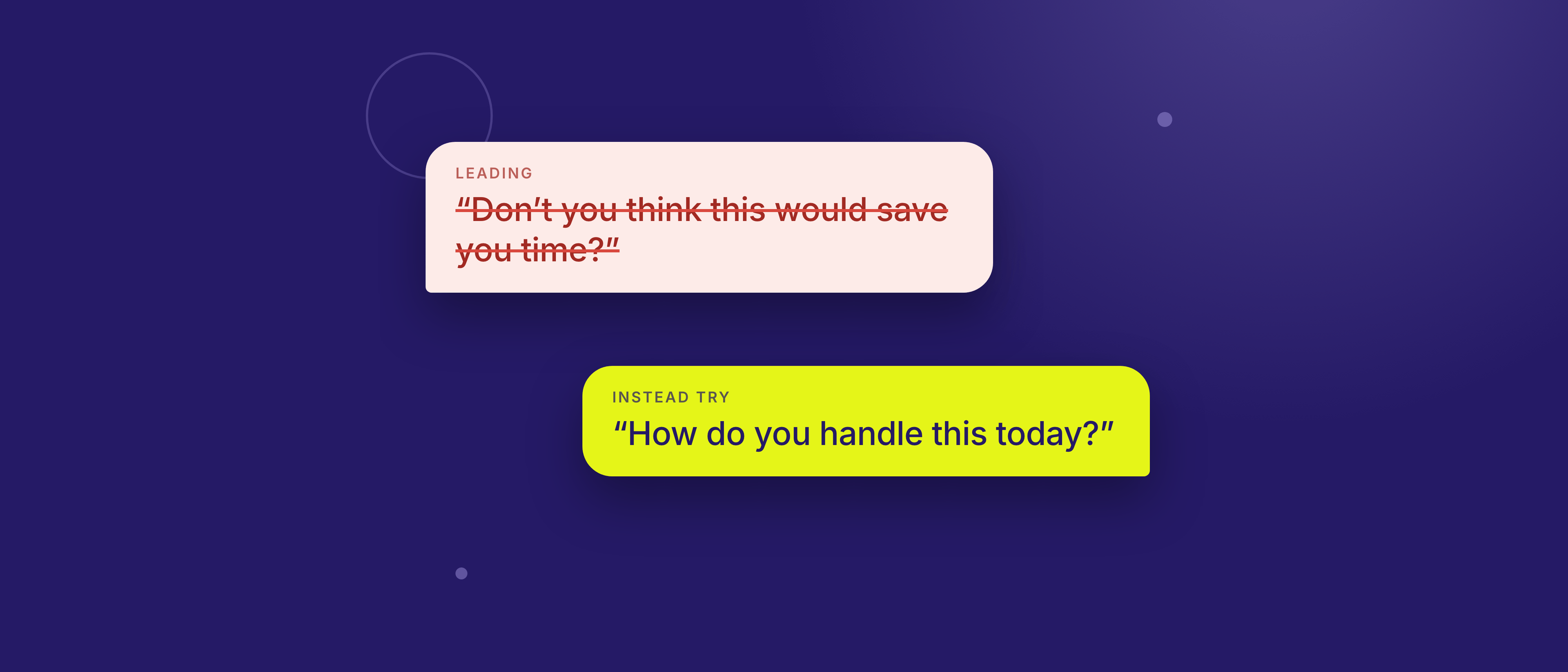
- “Don’t you think…?” It’s a closed, leading question in disguise.
- “What problems do you have with…?” It assumes problems exist. Try “How does it work for you?”
Too open can also be a problem
A question can be too open to answer well. “Tell me about your life” is technically open, but too broad. Anchor it to something specific:
- Too broad: “Tell me about your work.”
- Better: “Tell me about the last time a client asked you for something at the last minute.”
A quick test
Read your question aloud and ask yourself:
- Could they answer in one word? (If yes, it’s closed.)
- Does it contain my guess about the answer? (If yes, it’s leading.)
- Is it about something that already happened? (If yes, it’s likely good.)
Before a call, you can run your whole question list through this test with the discovery call checklist.
Check your own calls
Seeing your own mix of open and closed questions is eye-opening. Paste a transcript into Verafair to find where a closed question shut down a story, and get exact rephrasing suggestions.
Frequently asked questions
What are some examples of open-ended questions? “Tell me about the last time you…”, “Walk me through how you…”, “What happened when…?” and “How did you decide…?” are all open-ended, because they can’t be answered in one word and invite a story. This page lists 30+ examples, grouped by situation.
What is the difference between open-ended and closed-ended questions? An open-ended question lets the person answer in their own words, such as “How do you handle this today?” A closed-ended question limits the answer to yes or no, a short fact, or a set of options, such as “Did you use it last week?”
What are 5 examples of closed-ended questions? “Did you use it last week?”, “How many people are on your team?”, “Which of these tools do you use?”, “On a scale of 1 to 5, how easy was that?” and “Would you recommend it?” Each can be answered with a word, a number or a choice.
Are closed questions bad? No. They’re useful for confirming facts, scheduling, screening and surveys. They become a problem when you use them to explore opinions or test your own ideas.
Is “why” an open-ended question? Yes, but it can feel like a challenge, and people start defending their choices. “What led to that?” or “What was going on?” usually gets a more relaxed answer.
How many open-ended questions should I ask? In an interview, most of your main questions should be open, with a few closed ones to confirm details. In a survey, it’s usually the reverse, since people skip open questions more often.
Related guides
- Leading questions in customer interviews: 15 examples and better rewrites
- Follow-up questions cheat sheet: 20 ways to say “tell me more”
- Customer discovery questions: 30 open-ended questions to ask
- Sales discovery questions: 25 that qualify without pitching
- Discovery call checklist: before, during and after
- How to audit your own customer discovery calls
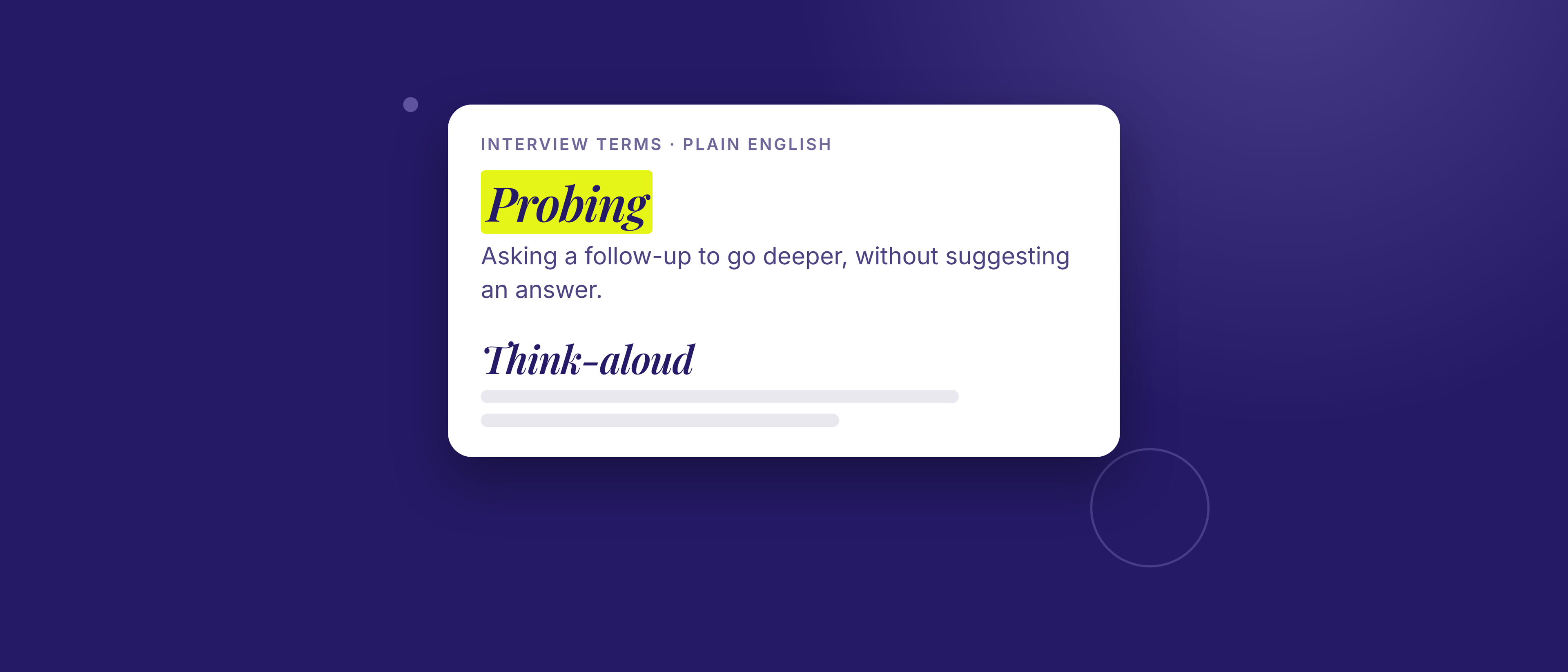
- Customer interview terms in plain English