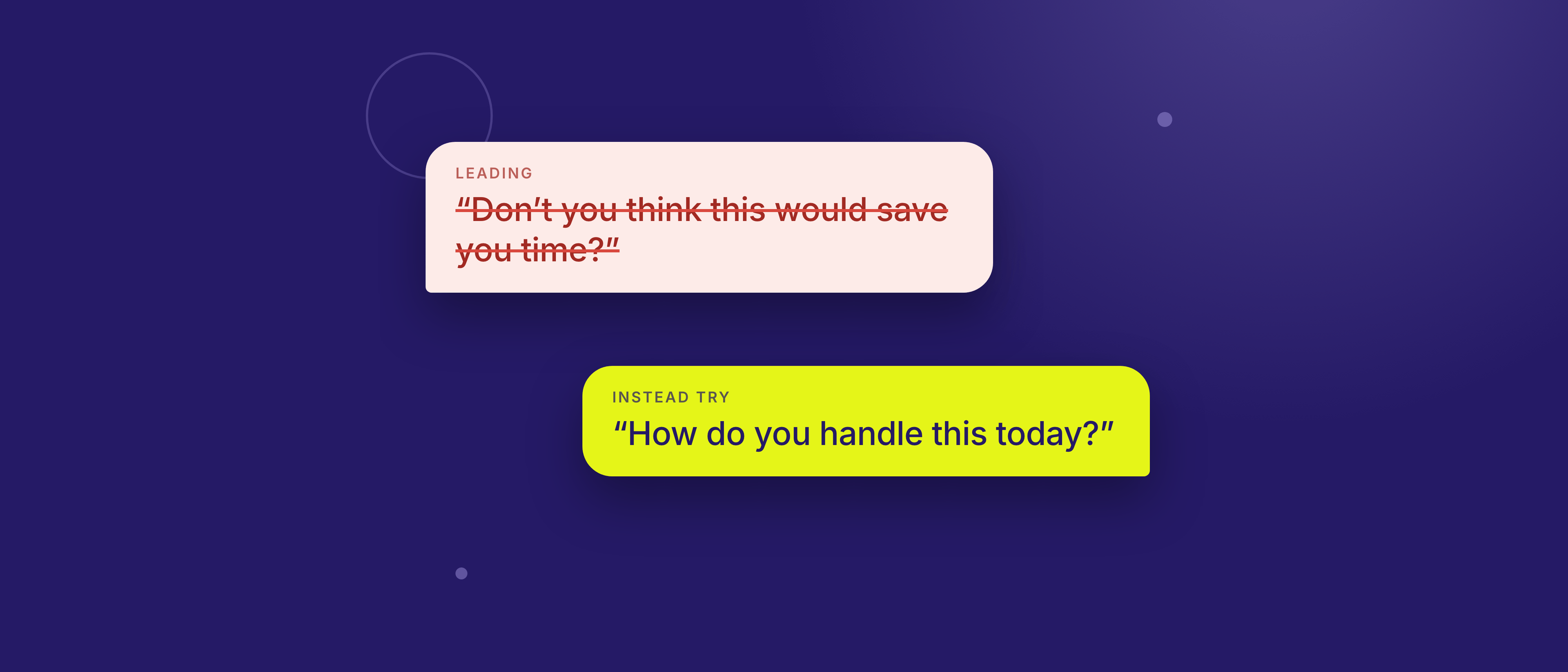
A leading question is a question worded so that it suggests the answer the asker expects or wants. Because the hint is built into the wording, people tend to go along with it instead of describing what is true for them. “Don’t you think this is easier?” is leading; “How did this compare with what you used before?” is not.
The term comes from law (“leading the witness”) and is used the same way in surveys and psychology. This guide focuses on customer and user interviews, where a leading question quietly turns your assumptions into “evidence.”
Download the one-page Rewrite Cheat Sheet (PDF) to keep beside you when you write your questions.
What does “leading question” mean in law, surveys and interviews?
In every setting, the wording supplies the answer. What changes is the cost.
- In court, “leading the witness” is restricted. Under US Federal Rule of Evidence 611(c), they generally aren’t used when questioning your own witness, but are allowed on cross-examination (Federal Rules of Evidence, Rule 611(c), via Cornell Law School).
- In surveys, it skews the numbers for everyone who answers. In a 2005 Pew Research Center survey, 51% favored “making it legal for doctors to give terminally ill patients the means to end their lives,” but only 44% favored “making it legal for doctors to assist terminally ill patients in committing suicide” (Pew Research Center, “Writing Survey Questions”).
- In customer interviews, it gets you a polite “yes” to your own idea, which then gets written up as a finding.
Why do leading questions distort answers?
Leading questions distort answers because people take cues from the wording and from the person asking, and most would rather agree than correct you. Three documented effects are at work:
- The interviewer is the authority in the room. Many participants don’t want to disagree with the person running the session, so they echo the interviewer’s framing (Amy Schade, Nielsen Norman Group, 2017).
- Agreeing is the easy answer. Survey researchers call this “acquiescence bias,” and Pew Research Center notes it, like social desirability bias (giving the answer that makes you look good), is stronger when an interviewer is present (Pew Research Center, “Writing Survey Questions”).
- Words change what people remember. In Loftus and Palmer’s 1974 car-crash study, people asked how fast the cars were going when they “smashed” into each other estimated 40.8 mph on average; with “contacted,” 31.8 mph. A week later, 32% of the “smashed” group recalled broken glass, against 14% of the “hit” group. There was none in the film (Loftus & Palmer, Journal of Verbal Learning and Verbal Behavior, 1974).
People are also polite. If you ask, “Wouldn’t it be great if this were faster?”, they will agree, even if speed has never crossed their mind. You leave the call feeling validated, and you have learned nothing you can rely on.
In a customer interview, that causes three problems:
- False confirmation. You hear “yes” to your own idea and treat it as demand.
- Missed problems. You never hear the issue you didn’t think to ask about.
- Wasted calls. You get answers you could have gotten from a colleague.
How can you tell if a question is leading? The 4-part test
A question is leading if it contains the answer, signals a “right” answer, boxes the person into yes or no, or asks them to predict the future. If any of these four checks comes back yes, rewrite it.
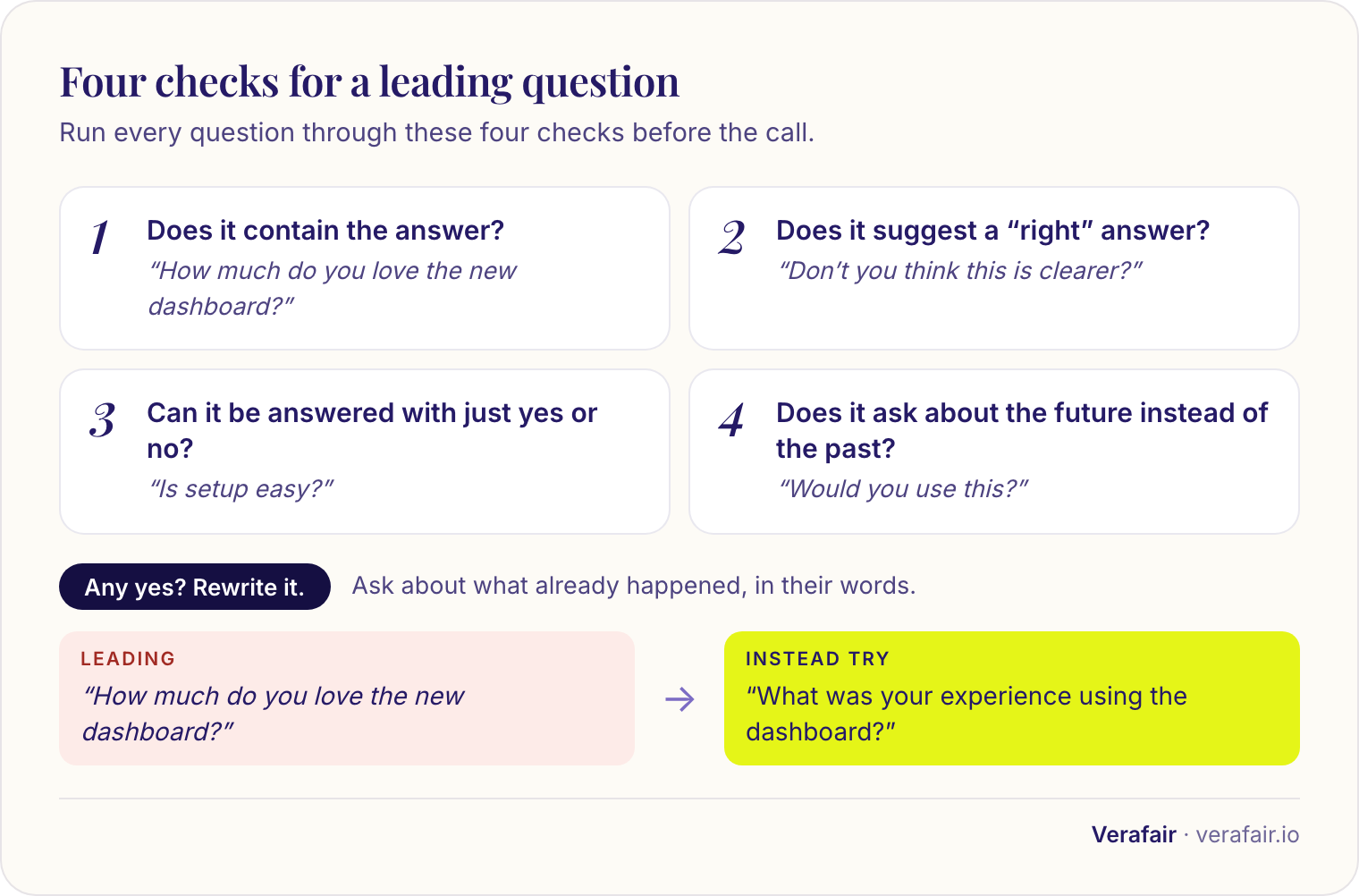
- Does it contain the answer? (“How much do you love the new dashboard?”)
- Does it suggest a “right” answer? (“Don’t you think this is clearer?”)
- Can it be answered with just yes or no? (“Is setup easy?”)
- Does it ask about the future instead of the past? (“Would you use this?”)
The fix is almost always the same: ask about what already happened, in their words, and let them tell the story.
Leading vs loaded vs open questions: what’s the difference?
A leading question pushes toward an answer, a loaded question builds in an assumption the person may not share, and an open question leaves the answer to them.
| Type | What it does | Example | Neutral version |
|---|---|---|---|
| Leading | Suggests the answer you want | “You’d switch if it saved you an hour a week, right?” | “What would it take for you to change how you do this?” |
| Loaded | Builds in an unproven assumption | “What do you hate most about your current tool?” | “What’s it like using your current tool day to day?” |
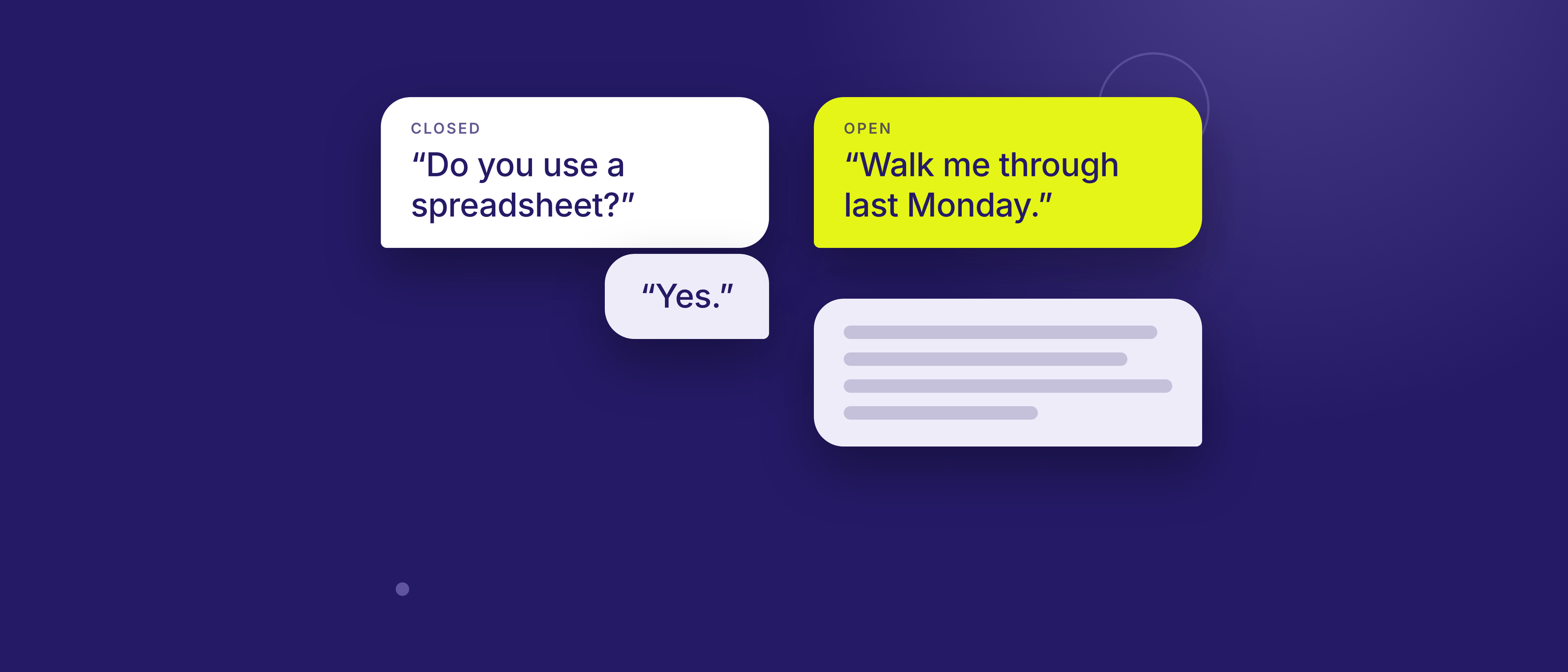
| Open | Leaves the answer entirely to them | “Tell me about the last time you did this.” | — already neutral |
The classic loaded question is “Have you stopped beating your wife?”, where any direct answer accepts the premise. For more, see 30+ open-ended question examples.
15 leading question examples with better rewrites
Type 1: Questions that assume the answer (assumption-based)
| # | Leading version | Why it leads | Better version |
|---|---|---|---|
| 1 | “How much do you love the new dashboard?” | It assumes they love it. | “What was your experience using the dashboard?” |
| 2 | “What frustrates you about your current reporting process?” | It assumes frustration exists. | “Walk me through how you put together your last report.” |
| 3 | “Why is the onboarding so confusing?” | It tells them it is confusing. | “Tell me about your first week with the product. What happened?” |
Type 2: Pitches disguised as questions (direct implication)
| # | Leading version | Why it leads | Better version |
|---|---|---|---|
| 4 | “Wouldn’t it be helpful if the tool flagged problems automatically?” | You are selling your idea, not learning. | “How do you spot problems today? What happens when you miss one?” |
| 5 | “If we built this, you’d use it, right?” | It asks for a promise, not a fact. | “Tell me about the last time you needed to do this. What did you use?” |
| 6 | “Do you think a mobile app would make your job easier?” | It steers them toward your solution. | “Where do you usually do this work, and what gets in the way?” |
Type 3: Yes/no traps
| # | Leading version | Why it leads | Better version |
|---|---|---|---|
| 7 | “Is the pricing clear?” | Yes/no hides what they understood. | “Tell me what you took from the pricing page.” |
| 8 | “Did you find setup easy?” | It invites a polite “yes.” | “Talk me through how setup went.” |
| 9 | “Do you have problems with your current tool?” | It pushes them to invent a problem. | “How does your current tool fit into your week?” |
Type 4: Questions about future behavior
| # | Leading version | Why it leads | Better version |
|---|---|---|---|
| 10 | “Would you pay for this?” | People are poor at predicting what they will buy. | “What do you pay for today to solve this? When did you last decide to buy something like it?” |
| 11 | “How often would you use this?” | It gets a guess, not a habit. | “How often did you do this in the last month?” |
| 12 | “Would you recommend it to a colleague?” | It rewards politeness, not experience. | “Have you recommended a tool to a colleague recently? What made you do it?” |
Type 5: Nudges and narrowing (coercive or tag questions)
| # | Leading version | Why it leads | Better version |
|---|---|---|---|
| 13 | “Most people find this step annoying. Do you?” | It sets a social norm to agree with. | “How was this step for you?” |
| 14 | “Don’t you think the new layout is cleaner and faster?” | It supplies both the opinion and the reasons. | “What differences did you notice between the old and new layouts?” |
| 15 | “So the real problem is speed, right?” | It closes the topic before they have finished. | “What would you say the biggest problem is, in your own words?” |
What does a leading question look like in a call?
Illustrative example.
Before
Interviewer: “So you’d agree that tracking all your clients in one place would save you a lot of time, right?” Participant: “Yeah, I guess so.”
The answer sounds positive, but it tells you nothing. The participant agreed with a statement, not with an experience.
After
Interviewer: “Tell me about the last time you had to check on several clients at once.” Participant: “Last Thursday, actually. I had five different tabs open and I still missed one who’d emailed me twice.”
Now you have a real moment, a real cost, and a detail you can ask about next.
What should you do when you notice you led?
When you catch yourself leading, take the question back and let the participant answer in their own words. Everyone slips:
- Take it back. “Let me rephrase that. I don’t want to put words in your mouth.”
- Hand it back to them. “Forget my question. In your own words, what happened?”
- Use silence. Wait a few seconds after an answer before you speak. People often add the most useful detail right after a pause.
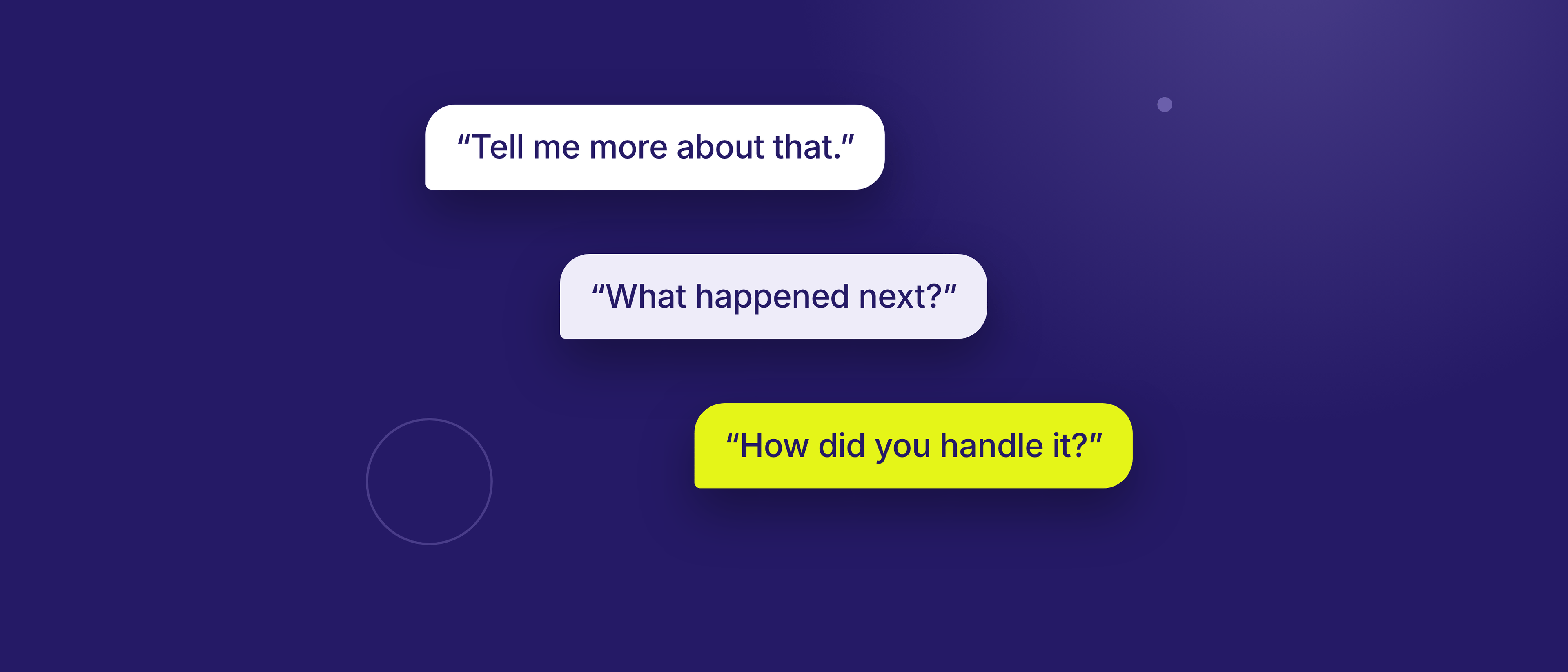
- Follow with “tell me more.” It is neutral, and it works after almost any answer. The follow-up questions cheat sheet has 20 more.
How it changes by type of call
The risk looks a little different in each kind of conversation:
- Product discovery calls: the risk is pitching your idea. Aim to hear needs, pain points and workflows through open questions, anchored in specific past situations. Customer discovery questions has 30 to start from.
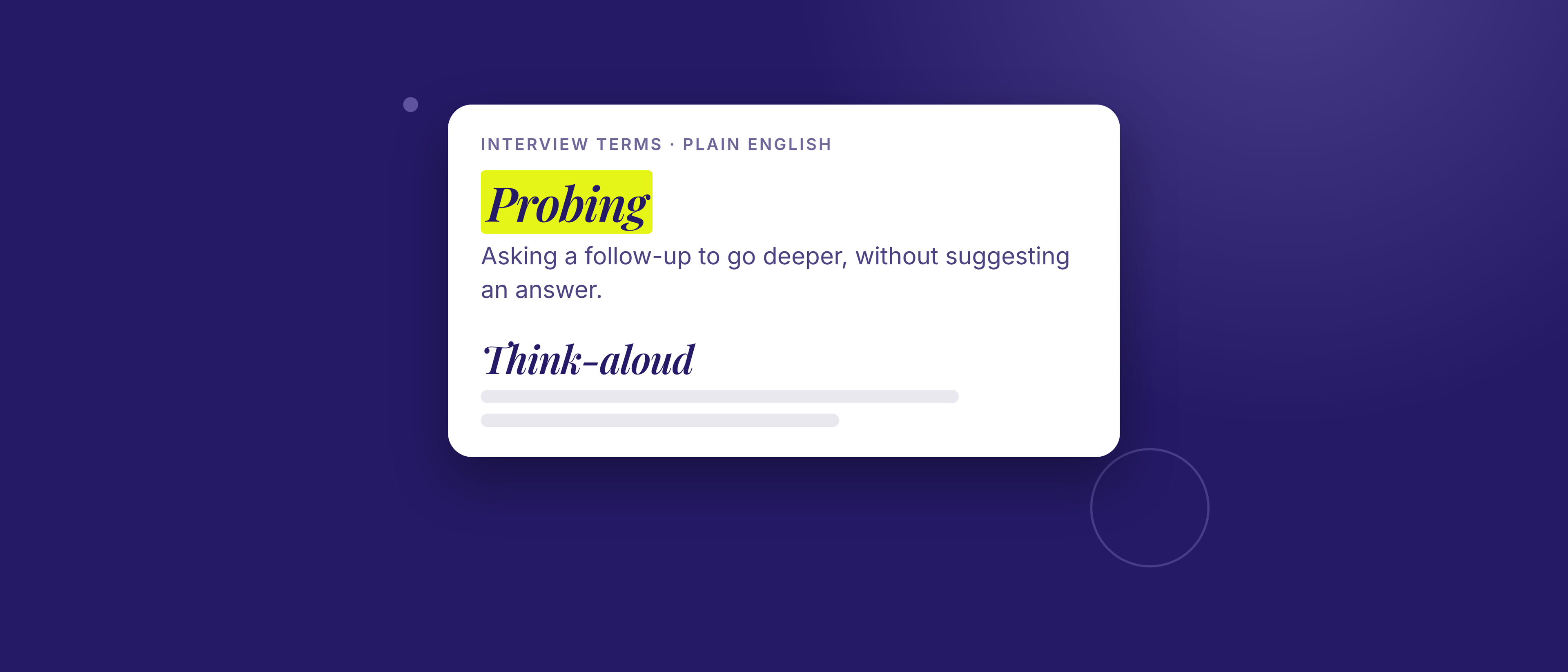
- Usability sessions: the risk is jumping in too soon. Let people think aloud and struggle a little before you help, and note where and why they got stuck, not just whether they succeeded.
- Focus groups: the risk is letting the loudest voice set the tone. Draw in quieter participants and explore disagreement instead of rushing to consensus.
- Concept testing: the risk is explaining before you listen. Get their unprimed first reaction before you say what you meant, and ask separately about what they understood and what they liked or disliked.
Check your own calls
Reading about leading questions helps. Seeing your own is faster. Run a call transcript through Verafair to get a plain-language report showing the exact moments you led, why they matter, and the words to use instead.
Frequently asked questions
What is a leading question? A leading question is worded to suggest the answer the asker expects, so the person responds to the hint instead of their own experience. “You found setup easy, didn’t you?” is leading; “How did setup go?” is not.
What is an example of a leading question? “Wouldn’t it be helpful if the tool flagged problems automatically?” pitches an idea and invites a polite yes. A neutral version is “How do you spot problems today?”
What does “leading the witness” mean? It means asking a witness a question that puts the answer in their mouth. In US federal courts, leading questions are generally not used on your own witness but are allowed on cross-examination.
What is the difference between a leading and a loaded question? A leading question pushes toward a particular answer. A loaded question contains an assumption the person may not share (“What do you hate about your current tool?”), so any direct answer accepts the premise.
Are all yes/no questions leading? No. Yes/no questions are fine for confirming a fact (“Did you use it last week?”). They become a problem when you use them to test your own idea or to ask about feelings and opinions.
Why shouldn’t I ask “would you use this?” People are unreliable at predicting their own future behavior, and they tend to be kind to the person asking. Asking about what they did in the past gives you information you can trust.
Related guides
- How to audit your own customer discovery calls
- Discovery call checklist: before, during and after
- Customer discovery questions: 30 open-ended questions to ask
- Follow-up questions cheat sheet: 20 ways to say “tell me more”
- Sales discovery questions: 25 that qualify without pitching
- 30+ open-ended question examples (and how they differ from closed questions)