To audit a customer call, you review its recording or transcript against five things that decide whether you learned anything true: whether you asked open questions, heard real stories about past events, followed up when it mattered, avoided steering the answers, and did what that type of call is for. Then you pick the three biggest issues, the three biggest strengths, and one change for your next call. The first audit takes about an hour, and you need nothing but a transcript and a pen.
Want a head start? Download the Discovery Call Checklist (PDF), which covers what to do before, during, and after a call.
Most people skip this, because nobody enjoys listening to themselves. But you can’t hear your own habits mid-conversation; a calm read-through afterwards shows you exactly what happened.
Why audit your calls at all?
You audit your calls because a call that felt good and a call that taught you something are often different things. It’s easy to leave a conversation happy because the person was friendly and agreed with you. Rob Fitzpatrick’s The Mom Test is built around this trap: people tell you what they think you want to hear. The audit asks a harder and more useful question: would I make a better decision because of what I heard?
An audit also turns vague advice (“ask better questions”) into something you can act on (“in minute 12 I asked a yes/no question about pricing; here’s what I’ll ask next time”).
Researchers treat this as normal practice. Nielsen Norman Group’s Maria Rosala writes (2019) that interviewing takes practice and reflection, and that people who rewatch their recordings and analyse their own transcripts become better practitioners.
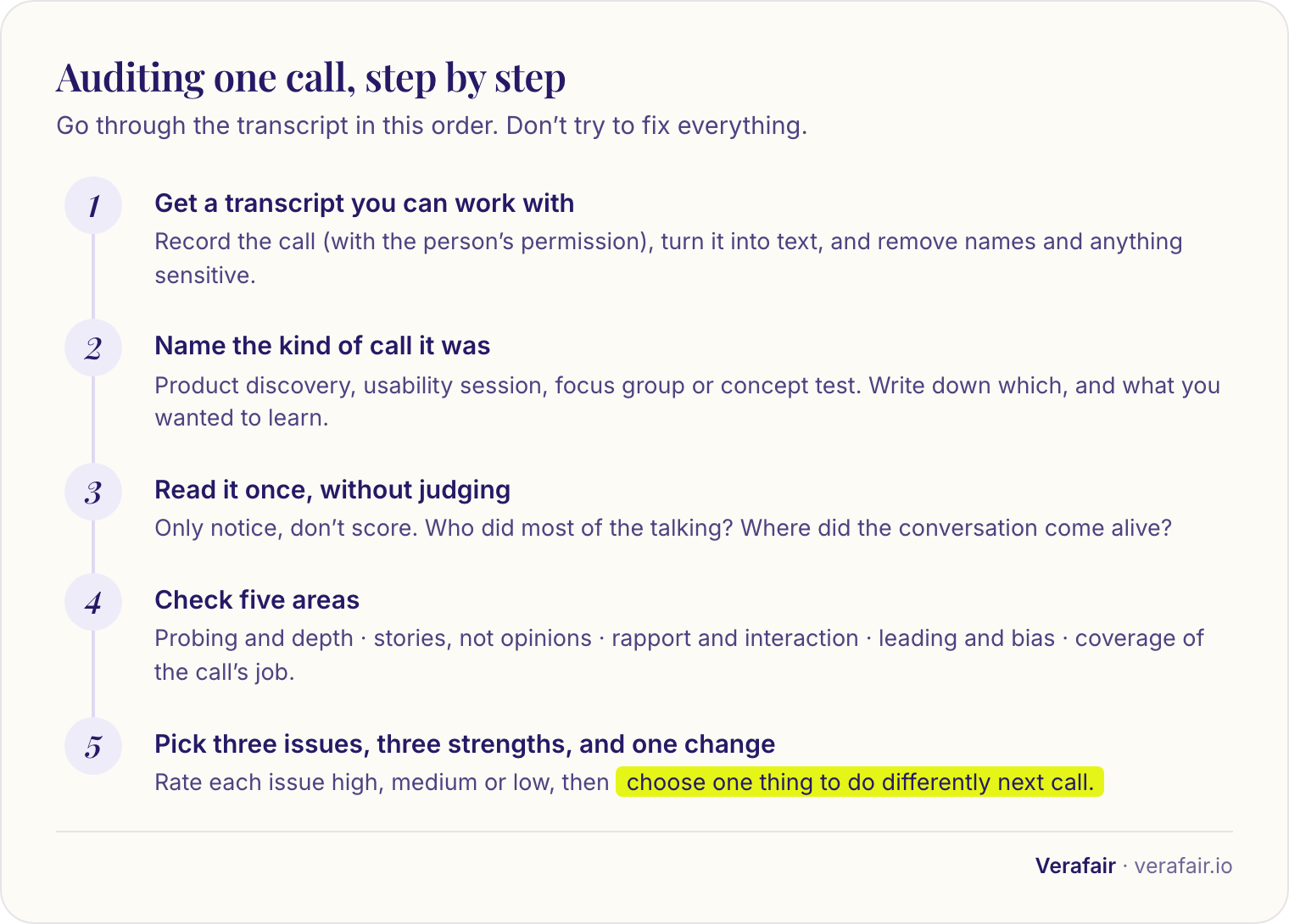
The 5-step audit
Step 1: Get a transcript you can work with
Record the call (with the person’s permission) and turn it into text. Most video call tools can do this. Then remove names, companies, and anything sensitive before you share the text or paste it into any tool. Timestamps and speaker labels are a bonus, because they let you point at exact moments.
Step 2: Name the kind of call it was
Different calls have different jobs, so “good” looks different. Pick the one that fits:
| Call type | What a good call looks like |
|---|---|
| Product discovery | You uncover needs, pain points, and how work really happens, through open questions. You don’t pitch. Answers are tied to specific past situations. |
| Usability session | The person thinks aloud. You let them struggle before you step in. You capture where and why they got stuck, not just whether they succeeded. |
| Focus group | Quieter people get heard. You explore disagreement instead of rushing to agreement. Your summaries don’t narrow the group’s view. |
| Concept testing | You get an unprimed first reaction before you explain your idea. You ask what they understood and what they liked or disliked as two separate things. You don’t sell or fish for praise. |
Write down which one it was, and what you wanted to learn. For more on each type, see the usability session checklist, testing a concept without selling it, and quiet participants in focus groups. Sales calls work too: judge the discovery part against sales discovery questions that qualify without pitching.
Step 3: Read it once, without judging
Read the whole transcript straight through. Only notice, don’t score. Two quick questions help:
- Who did most of the talking? In a good discovery call, the participant does. NN/g’s guidance on interview facilitation mistakes (Fessenden, 2021) is to speak calmly and slowly and try not to talk more than the participant. If half the transcript is yours, note it.
- Where did the conversation come alive? Look for the moments where the person told a story or said something that surprised you. Then look at what you said just before.
Step 4: Check five areas
Go back through with a pen. For each area, look for the good signs and the warning signs.
| Area | Good signs | Warning signs |
|---|---|---|
| Probing and depth | You follow up on interesting answers (“Tell me more,” “What happened next?”) | You move to your next question after every answer |
| Stories, not opinions | You get specific past examples (“Last Thursday, I…”) | Answers are general (“I usually…”, “Most people…”) or about the future (“I would…”) |
| Rapport and interaction | The person relaxes, jokes, or shares more as it goes; you leave space for silence | You interrupt, finish their sentences, or rush |
| Leading and bias | Your questions are neutral and open | You hint at the answer, pitch your idea, or ask yes/no questions about opinions |
| Coverage of the call’s job | You did the core moves for your call type (see the table in Step 2) | You skipped the parts that matter most for this type of call |
Each area maps to a well-documented way interviews go wrong:
- Probing: NN/g lists too few probing questions (2021) as a core facilitation mistake. Try the follow-up questions cheat sheet.
- Stories: Teresa Torres of Product Talk explains (2022) that asking what people “generally” or “usually” do is where cognitive biases creep in, so ask about the last time instead.
- Leading: NN/g defines a leading question (Schade, 2017) as one that includes or implies the desired answer. See 15 leading questions and better rewrites and open-ended vs closed questions.
Step 5: Pick three issues, three strengths, and one change
Don’t try to fix everything. Choose the three issues that most changed what you learned, and the three things you did well (you’ll want to keep doing them). Then choose one thing to do differently next call.
Rate each issue so you know where to start:
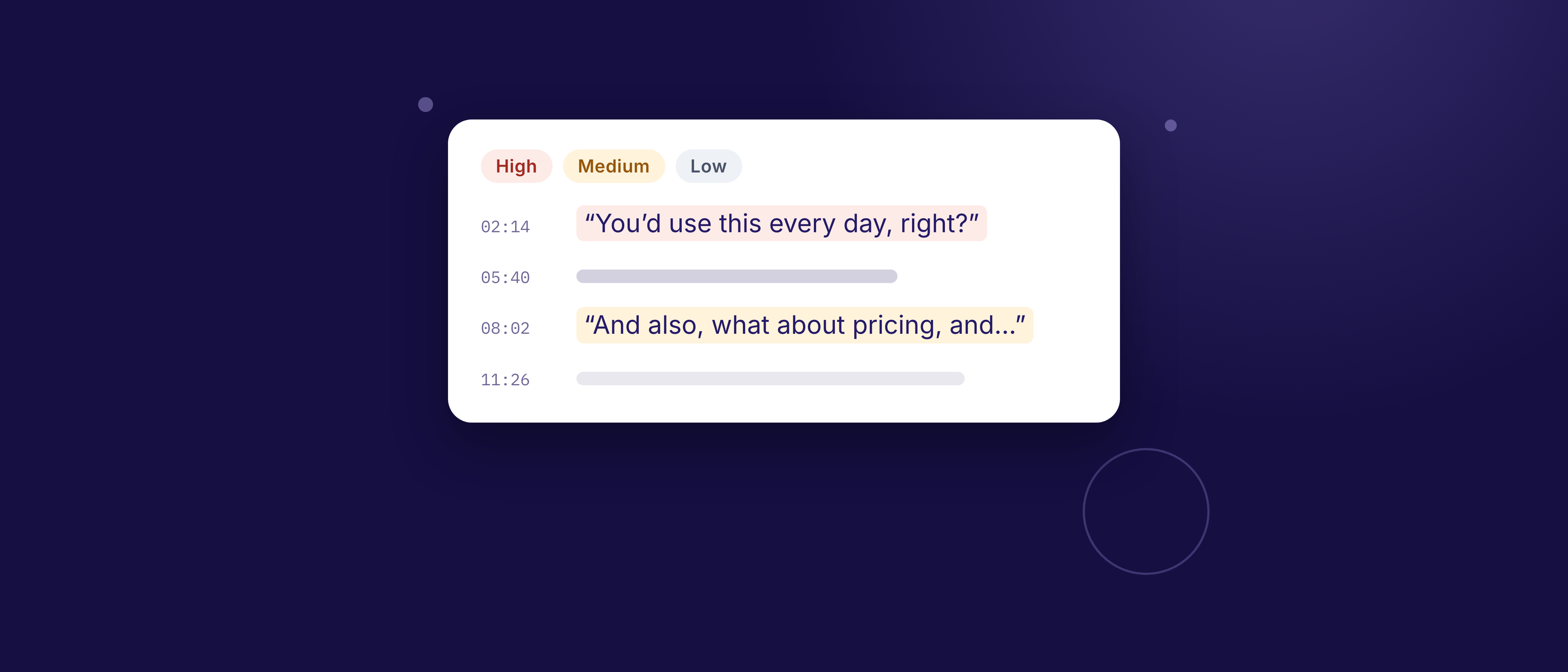
- High: it changed what you learned. The answers can’t be trusted.
- Medium: it weakened the call. You got answers, but thinner than you needed.
- Low: polish. Worth fixing once the bigger things are sorted.
A scoring sheet you can copy
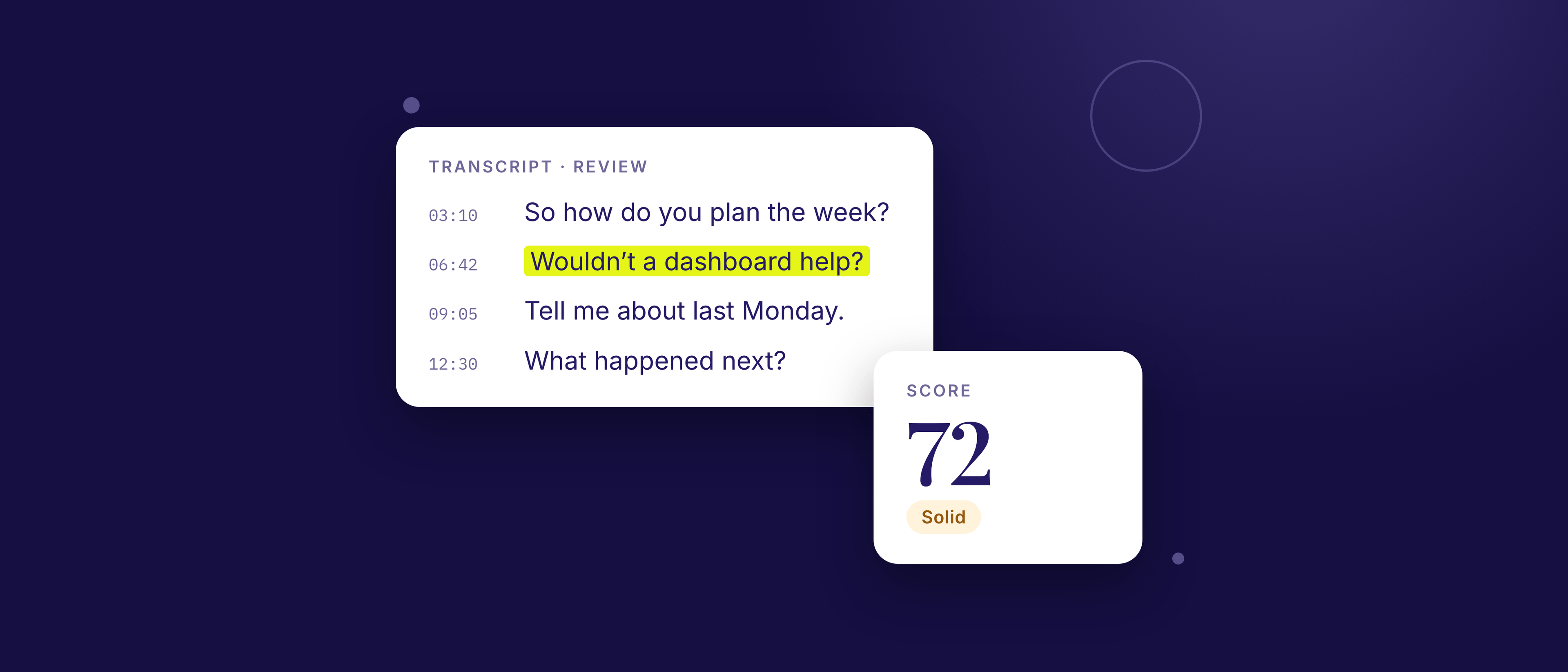
To score a call, give each of the five areas a 0 (mostly warning signs), 1 (mixed) or 2 (mostly good signs), and write one quote next to each score as evidence. This is a self-tracking tool, not an industry benchmark: its value is in comparing your own calls over time.
| Area | Score (0–2) | Quote that shows it |
|---|---|---|
| Probing and depth | ||
| Stories, not opinions | ||
| Rapport and interaction | ||
| Leading and bias | ||
| Coverage of the call’s job |
A total out of 10 is handy for a trend line, but the quotes are what you act on, and one high-severity issue (like pitching before you heard the problem) outweighs a good total.
What one finding looks like
Here’s how to write down an issue so it’s useful next week, not only today:
Quote: “So you’d agree that tracking everything in one place would save you a lot of time, right?” (Minute 6) Why it matters: It contains the answer, so a polite “yeah, I guess” tells you nothing about their real situation. Try instead: “Tell me about the last time you had to check on several things at once.”
A quote, a reason, and a rewrite. If your notes have all three, you can act on them.
How often should you audit your calls?
Audit your first one or two calls closely, then one call every few weeks, or whenever you change your questions or start talking to a new kind of customer. Your main habits show up fast, so the regular audits are about checking whether your one change stuck. Before each new call, run through the discovery call checklist so the fix is in front of you.
Should you audit alone or with a peer?
Start alone, then bring in a peer once you have a few audits behind you, because a second person hears leading questions that sounded natural to you. NN/g’s Rosala suggests (2019) inviting a colleague you trust, or a mentor, to review your recordings or transcripts with you. Use the same five areas so the feedback is about the call, not the person, and share only transcripts the participant agreed to.
Common traps
- Auditing to feel bad. You’re looking for patterns, not proof you’re bad at this. Everyone leads a little.
- Fixing ten things at once. Pick one change per call. You’ll improve faster.
- Judging by how the call felt. Friendly doesn’t mean informative.
- Skipping the strengths. What you do well is as useful to know as what to fix.
Check your own calls
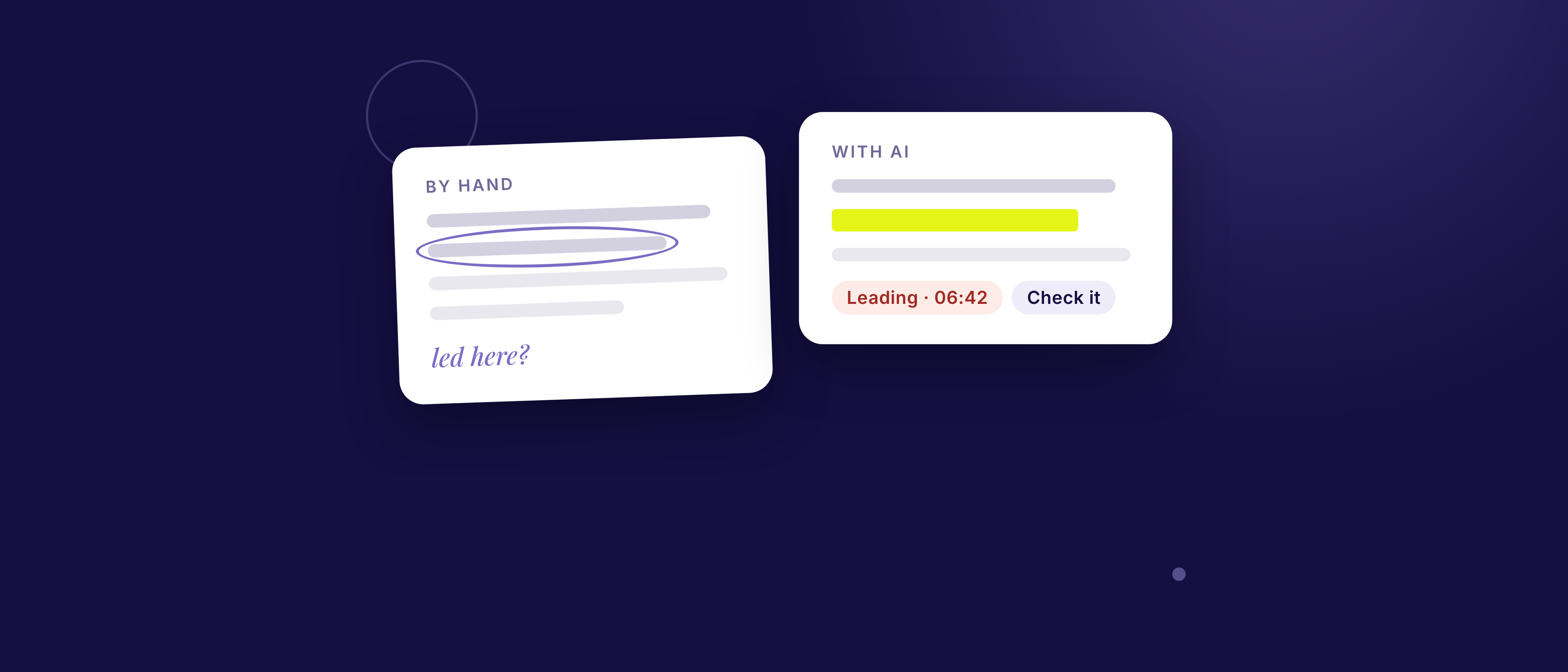
Doing the audit by hand teaches you a lot. If you want a faster first pass, paste your transcript into Verafair. Pick the call type and you’ll get a plain-language report: the one thing to fix first, a checklist of what your call type needs, your top three issues with exact quotes and rewrites, and your top three strengths.
Frequently asked questions
How do I know if a customer interview went well? A customer interview went well if you came away with specific stories about what the person actually did, in their own words, that you didn’t put there. If most answers are opinions, predictions, or agreement with your idea, the call felt good but taught you little.
How long does it take to audit a call? Plan on about an hour for a 45-minute call the first time. It gets faster as you learn what to look for.
Do I need a research background to audit my calls? No. The five areas in this guide are things anyone can spot with a transcript and a pen.
How many calls should I audit? Start with one or two to find your main habits. Then audit one call every few weeks to see whether they’re changing.
Is it okay to share a transcript with someone else? Only with the participant’s consent, and only after removing names and identifying details.
What should I fix first? Start with the highest-severity issue that affects the most questions. Leading questions and pitching are usually at the top, because they change the answers themselves.
Related guides
- Leading questions in customer interviews: 15 examples and better rewrites
- Discovery call checklist: before, during and after
- Sales discovery questions: 25 that qualify without pitching
- Follow-up questions cheat sheet: 20 ways to say “tell me more”
- How to review your interview transcripts: by hand vs with AI