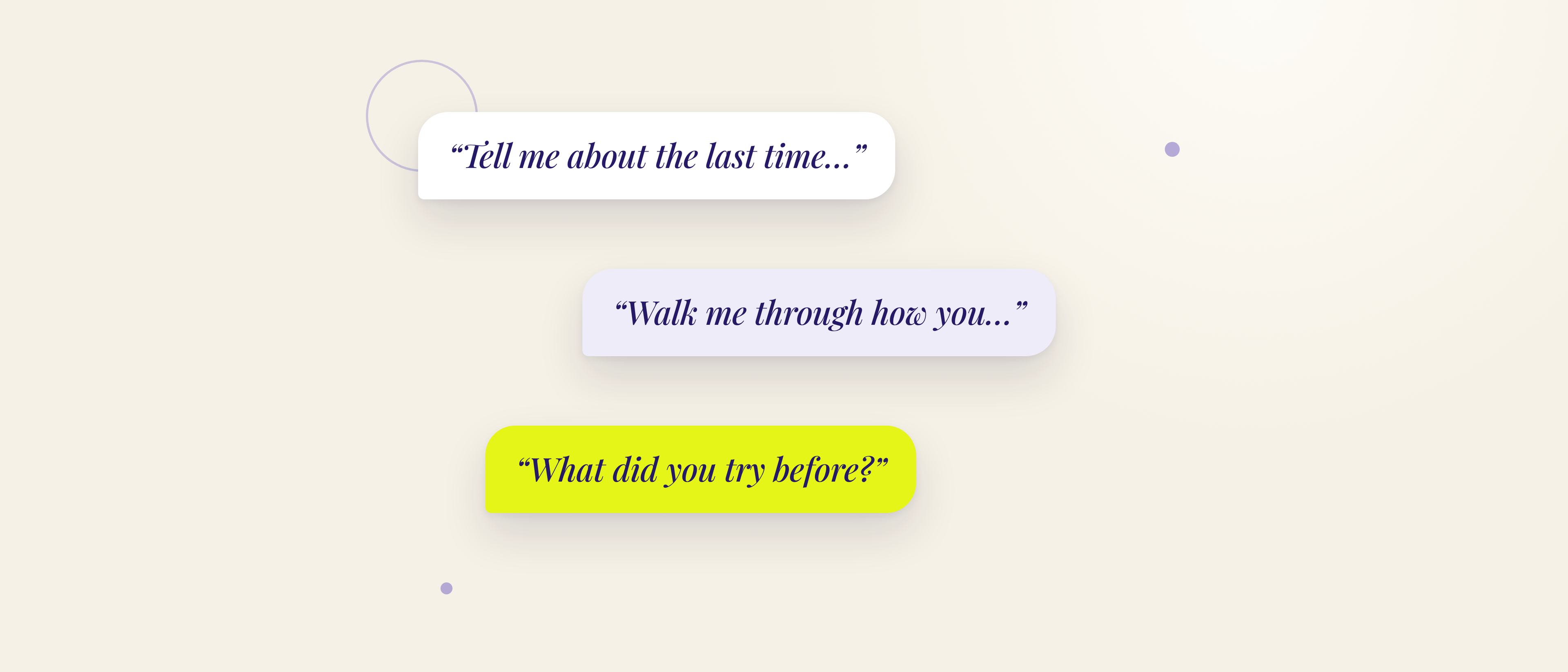
The best customer discovery questions are open-ended, about the past, and rooted in a specific moment. They sound like "Tell me about the last time you..." instead of "Would you ever...?" That isn't just taste: it's the core advice of Rob Fitzpatrick's The Mom Test, the reference book on customer conversations, and it matches what Nielsen Norman Group recommends for user interviews. Below are 30 questions you can use or adapt, grouped by what you're trying to learn.
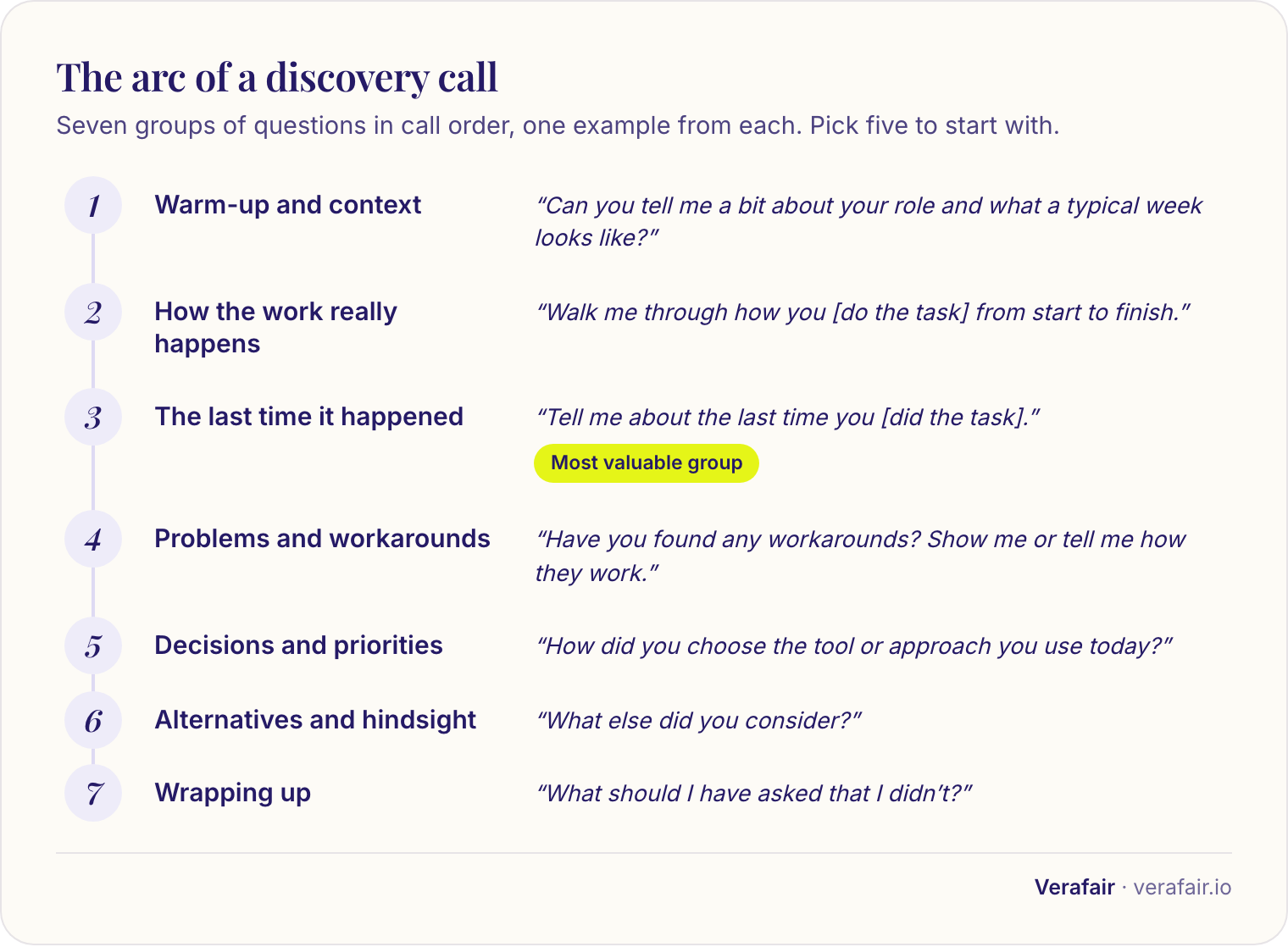
How to use this list: don't ask all 30. Pick 5 to start with, and let the answers decide your follow-ups. Swap the words in [brackets] for your own topic.
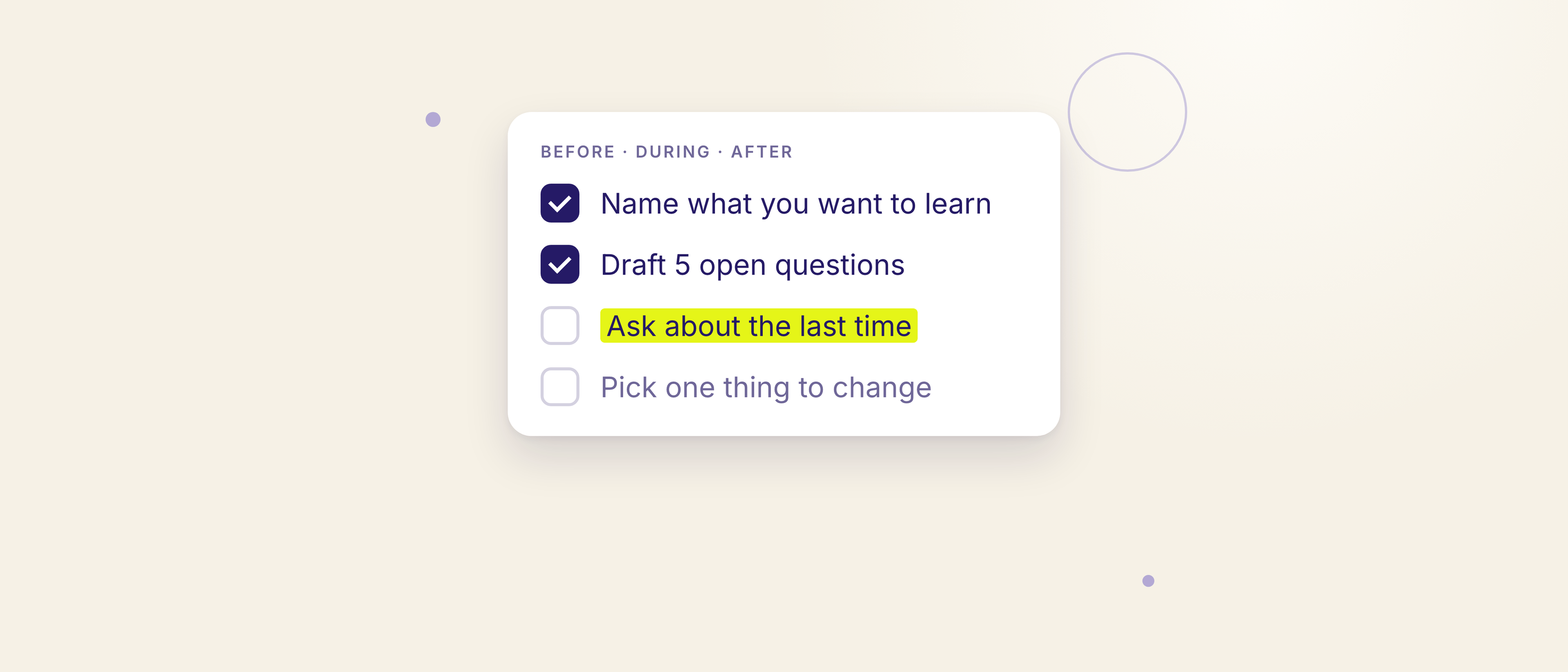
Download the Call Prep Template (PDF) to turn your five questions into a one-page plan.
What makes a good customer discovery question?
A good discovery question has three properties, and they come straight from The Mom Test, Rob Fitzpatrick's handbook on customer conversations: talk about their life instead of your idea, ask about specifics in the past instead of generics or opinions about the future, and talk less so they can talk more.
The research side agrees. Nielsen Norman Group's guidance on user interviews recommends a few well-designed, open-ended prompts — "Walk me through a typical day" or "Tell me about the last time you..." — and asking about specific past events, because a concrete incident nudges the person's memory and gets you meaningful detail instead of a vague summary. And in NN/g's comparison of open-ended vs closed questions, the case for open questions is that they let you find more than you anticipated, while closed questions tend to stop the conversation.
Asking instead of pitching isn't only a research habit. The study behind SPIN Selling — Neil Rackham's team at Huthwaite analyzed more than 35,000 sales calls — found that top performers in complex sales succeeded through structured questions about the customer's situation and problems, not through pitching features.
Every question below follows those rules. If you write your own, check them against the same three properties, then run them through the 4-part test in the leading questions guide.
Warm-up and context
- Can you tell me a bit about your role and what a typical week looks like?
- What are you responsible for that's most on your mind right now?
- How long have you been doing this work, and how did you get into it?
- What does a good day look like for you, compared with a bad one?
Use these to relax the person and get the lay of the land. Keep it short.
How the work really happens
- Walk me through how you [do the task] from start to finish.
- What's the first thing you do when [the trigger happens]?
- Who else is involved, and what do you need from them?
- What tools or documents do you use along the way?
- Where does most of the time go?
You're looking for the real process, not the official one.
The last time it happened
- Tell me about the last time you [did the task].
- What led up to it? What was going on that day?
- What happened next?
- What did you do when it didn't go to plan?
- How did it end up? Looking back, what would you change?
This is the most valuable group. Specific stories beat general opinions every time.
Problems and workarounds
- What's the hardest part of [the task]? Can you give me an example?
- Have you found any workarounds? Show me or tell me how they work.
- What have you tried before to fix this?
- What happens when this goes wrong, and who feels it?
- When did it last come up, and how often has it come up in the past few months?
Workarounds are a goldmine. If someone built a spreadsheet to solve it, the problem is real.
Decisions and priorities
- How did you choose the tool or approach you use today?
- Who else had a say in that decision?
- Have you ever changed how you do this? What triggered it?
- Where does this rank among everything else on your plate right now?
These tell you whether a problem is painful enough that anyone will act on it.
Alternatives and hindsight
- What else did you consider?
- What do you do when your usual approach doesn't work?
- What do you wish you had known before you started?
Wrapping up
- What should I have asked that I didn't?
- Is there anyone else I should talk to?
- If you could change one thing about how this works today, what would it be?
- Would it be alright if I followed up with a question or two later?
Which questions should you skip (and what should you ask instead)?
Skip questions that ask people to predict their future behavior or react to your idea. The Mom Test's central warning is that hypothetical questions get hypothetical answers — and that people, your mom most of all, will be kind about your idea rather than honest. Anchor on what already happened instead.
| Skip this | Because | Ask this |
|---|---|---|
| "Would you use a tool that...?" | Hypothetical questions get hypothetical, overly kind answers | "What do you do today when that comes up?" |
| "Do you have a problem with X?" | Yes/no, and it suggests a problem exists | "How does X fit into your week?" |
| "Why did you do that?" | Can feel like a judgment | "What led to that?" |
| "What do you think of our idea?" | Invites polite praise | "Tell me about the last time you needed something like this." |
How do you build your own five?
- Write your goal as a question ("How do they decide which clients to call first?").
- Pick one question from "The last time it happened" and one from "How the work really happens."
- Add one from "Problems and workarounds" and one from "Decisions and priorities."
- End with #27.
- Run each through the 4-part test in the leading questions guide.
Then plan to spend most of the call off-script: the prepared five open the topics, and the follow-up questions do the digging.
Check your own calls
A list of good questions helps, but how you ask and follow up matters just as much. Run a call transcript through Verafair to see whether your questions opened people up or shut them down.
Frequently asked questions
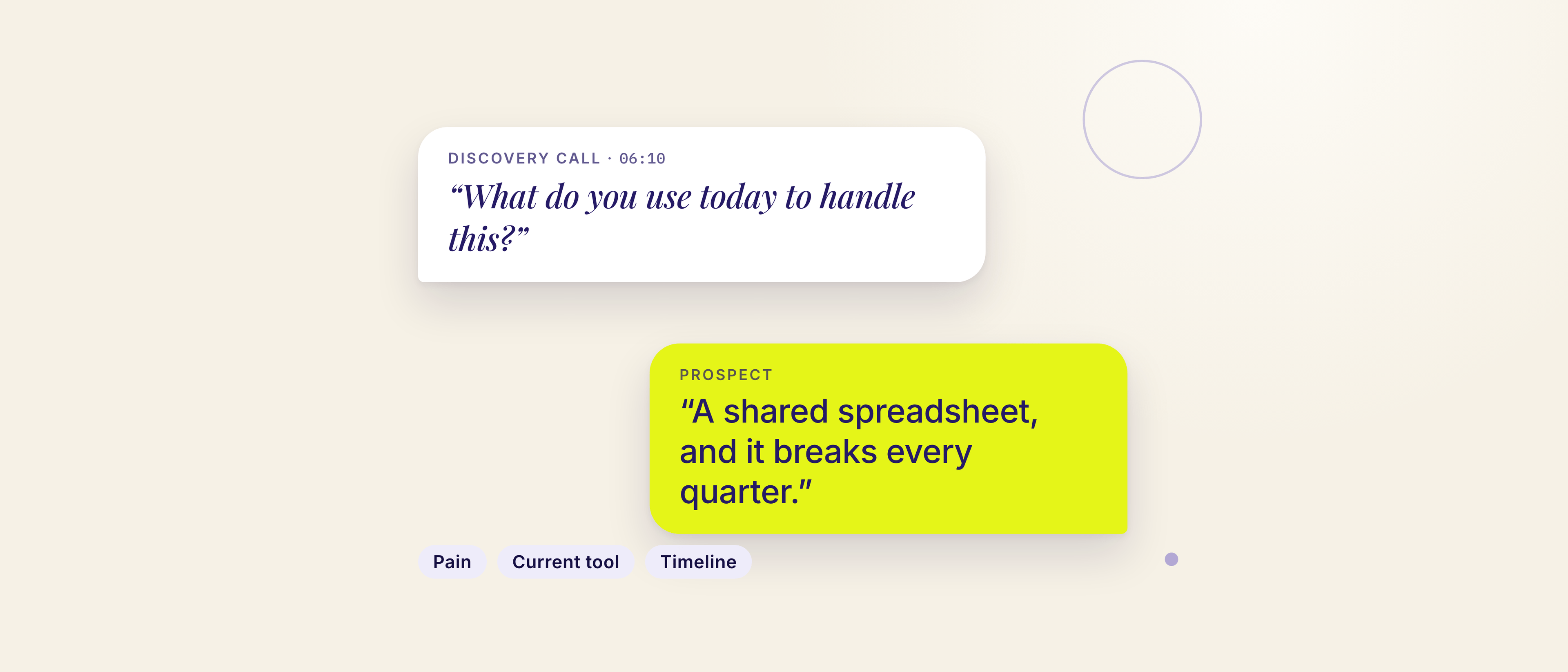
What are good questions to ask in a customer discovery call? Open-ended questions about the past, such as "Tell me about the last time you..." and "Walk me through how you...". They get you specific stories instead of opinions.
What is the Mom Test? It's Rob Fitzpatrick's rule of thumb for customer conversations: ask questions so grounded in the other person's real life that even your mom couldn't answer with a comforting lie. In practice: talk about their life, not your idea; ask about specifics in the past; and talk less than they do.
How many questions should I ask? You'll usually get through about five main questions in 30 to 45 minutes, plus many follow-ups. Depth beats coverage.
Should I ask about my product? Save it for the end, and ask about their experience before you explain it. Talking about your idea early tends to steer everything that follows.
What if they have nothing to say? Try anchoring on a recent moment: "Think about the last time you [did the task]. What was going on?" Concrete moments are easier to talk about than general topics.
Are these questions good for interviews with existing customers too? Yes. Adjust the topic, and add "What made you start using it?" and "What almost stopped you?" to hear the buying and switching story.
Related guides
- 30+ open-ended question examples (and how they differ from closed questions)
- Follow-up questions cheat sheet: 20 ways to say “tell me more”
- Leading questions in customer interviews: 15 examples and better rewrites
- Discovery call checklist: before, during and after
- Call prep template (printable): goal, assumptions and five open questions