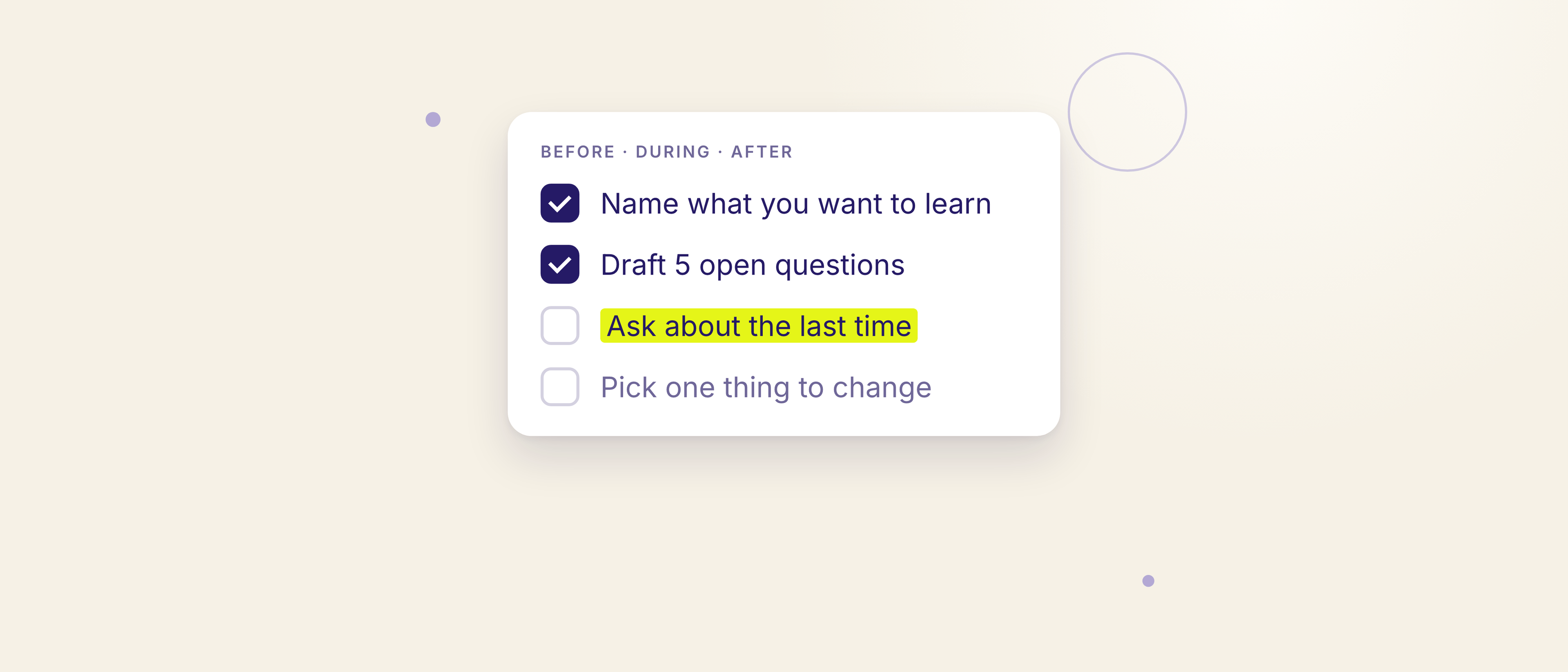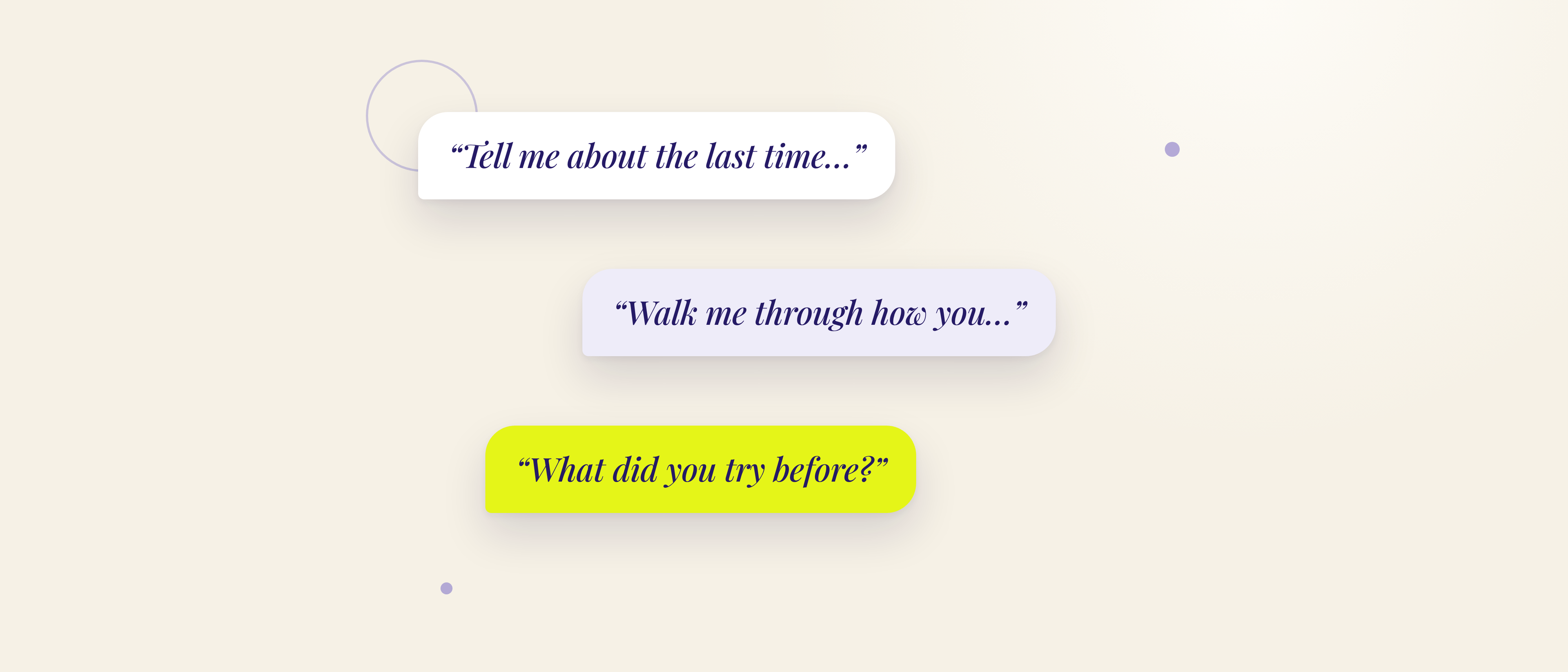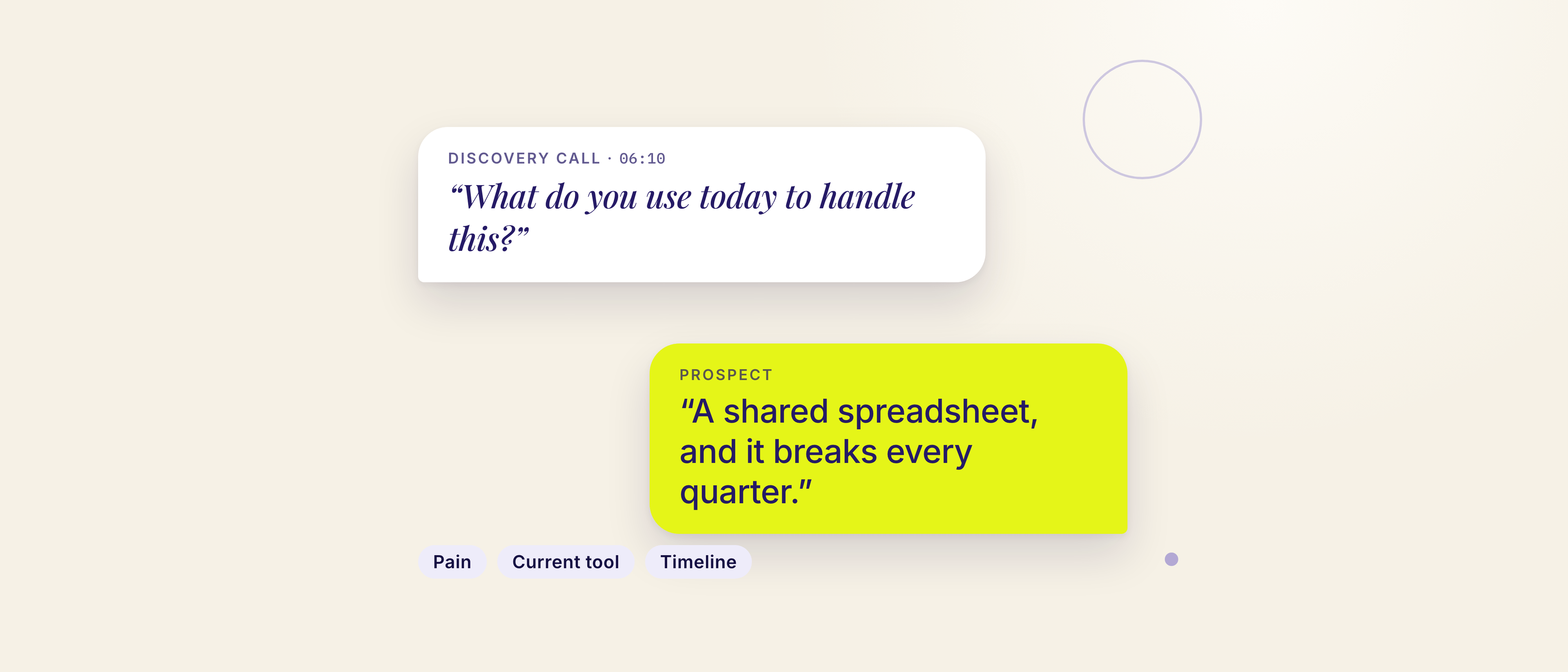
Good sales discovery questions ask about what a prospect already does, has tried, has spent, and is responsible for — not about the future or your product. “What do you use today to handle this?” tells you more than “Would you be interested in a tool like ours?” ever will, because it asks for a fact instead of a polite prediction. Below are 25 you can use, grouped by what you’re qualifying, plus the versions that quietly sink a lot of discovery calls and a short script to run the call.
Everything on this site about leading questions and open questions applies just as much to a sales call as it does to a product interview. The label on the call changes; the risk of hearing what you want to hear doesn’t.
What is a discovery call?
A discovery call is the first real conversation with a prospect in a sales process, where you learn their situation, problem, priorities, and buying process to decide whether there’s a fit worth pursuing. It comes before any demo or proposal, the prospect does most of the talking, and it’s just as useful when it tells you not to pursue a deal. Most run about 30 minutes; complex deals with several stakeholders can take 45 to 60 minutes or more than one call.
Why do sales discovery calls go wrong?
A product discovery call usually fails by pitching too early. A sales discovery call fails a little differently: it turns into a checklist of status questions (“Do you have budget? Are you the decision-maker? What’s your timeline?”) that reads like an interrogation and gets the answers a prospect thinks you want, not the real picture.
The fix isn’t just swapping closed questions for open ones. Neil Rackham’s team studied more than 35,000 sales calls over 12 years for SPIN Selling (1988), and the book counts “open questions are more effective than closed questions” among the beliefs its research found false for high-value sales (Routledge, SPIN®-Selling book description). What matters more is what you ask someone to report. A status or a prediction invites a polite guess; as Jakob Nielsen put it, “Definitely don’t believe what people predict they may do in the future” (NN/g, 2001).
So you can qualify the exact same things — budget, authority, need, timeline — by asking about what already happened. It’s the idea behind Rob Fitzpatrick’s The Mom Test: learning whether someone will really buy “even when everyone is lying to you.”
25 sales discovery questions, grouped by what you’re qualifying
The best discovery call questions ask about a specific, recent situation. You won’t need all 25: pick 8 to 10 that fit the deal and let the answers decide your follow-ups.
Their current situation
- Walk me through how you handle [the problem area] today.
- What are you using right now to deal with this?
- Who’s involved when this comes up, and what does each person do?
The pain, with evidence
- Tell me about the last time this caused a real problem.
- What did that end up costing you — in time, money, or something else?
- How often does this come up, and has that changed recently?
- What have you already tried to fix it?
Budget and priority (without asking “do you have budget”)
- What are you currently spending to deal with this, whether it’s a tool, a workaround, or people’s time?
- Where does this rank against everything else you’re dealing with this quarter?
- Has anyone tried to get this funded or approved before? What happened?
Decision process and stakeholders
- Who else would need to be involved before you could move on something like this?
- Tell me about the last time your team brought in a new tool. Who was part of that?
- What usually slows things down once you’ve decided you want to do something?
- What would you need to see to bring this to [the decision-maker]?
Timeline, grounded in something real
- What’s driving the timing on this right now?
- What happens if this isn’t solved by [a date they mention]?
- Has this been a priority for a while, or is something new pushing it?
Alternatives and switching
- What else have you looked at?
- What made you look into this now instead of six months ago?
- What would have to be true for you to switch from what you’re using today?
Wrapping up
- What should I have asked that I didn’t?
- Is there anyone else I should be talking to on this?
- What would make this call a waste of your time if we don’t cover it?
- What’s your honest read on how likely this is to move forward?
- Would it be alright if I followed up with a couple of questions after I’ve had a chance to think about this?
When an answer is vague (“it’s a pain,” “we’re looking at options”), ask for the example behind it before moving on; the follow-up questions cheat sheet has 20 ways to do that. For product interviews rather than deals, start from the customer discovery questions list.
Questions to stop asking (and what to ask instead)
Drop questions that ask for a status, a prediction, or agreement, because prospects answer those politely rather than accurately. Each has a version that gets the same information from something that already happened.
| Skip this | Because | Ask this |
|---|---|---|
| “Do you have budget for this?” | Asks them to declare a number on the spot, before they trust you with it | “What are you spending today to deal with this?” |
| “Are you the decision-maker?” | Feels like a qualification test, and invites a defensive or inflated answer | “Who else is usually involved when your team picks something like this?” |
| “Would you be interested in a demo?” | Asks for a future commitment, not a fact | “What would you need to see to know if this is worth your team’s time?” |
| “Is this a priority for you?” | Yes/no, and politely almost always gets “yes” | “Where does this rank against everything else on your plate?” |
| “Wouldn’t it help to have this solved?” | Leading — it supplies the answer | “What happens today when this comes up?” |
Watch the last row most closely. Leading questions produce biased or false answers because people mimic the interviewer’s words, and many “will not want to disagree” with the person running the session (NN/g, “Avoid Leading Questions,” 2017). On a sales call, where the prospect knows you want a yes, that pull is stronger. See 15 leading question examples and rewrites.
What good sounds like
Weak: “So, are you looking to solve this in the next quarter?” Participant: “Yeah, probably.”
Better: “What’s driving the timing on this right now?” Participant: “Honestly, our biggest client flagged it last month, and if it happens again we could lose them.”
The second version gives you a real trigger, a real stake, and a person you could ask a specific follow-up about. The first gives you a polite guess.
How do you structure a discovery call?
Put the prospect’s world first and your product last: open with their current situation, get one specific story, qualify through what already happened, and only then connect what you sell to what they told you.
- Open with their world, not your product. Ask about how the problem shows up today before you say what you sell.
- Get one specific story. A recent, concrete example beats a general description every time.
- Ask about cost, process, and timeline through what already happened, using the questions above, not a status checklist.
- Save your pitch for the end, and only cover what connects to what they actually told you.
- Close with an honest read, not a forced next step: “What’s your honest sense of whether this moves forward?”
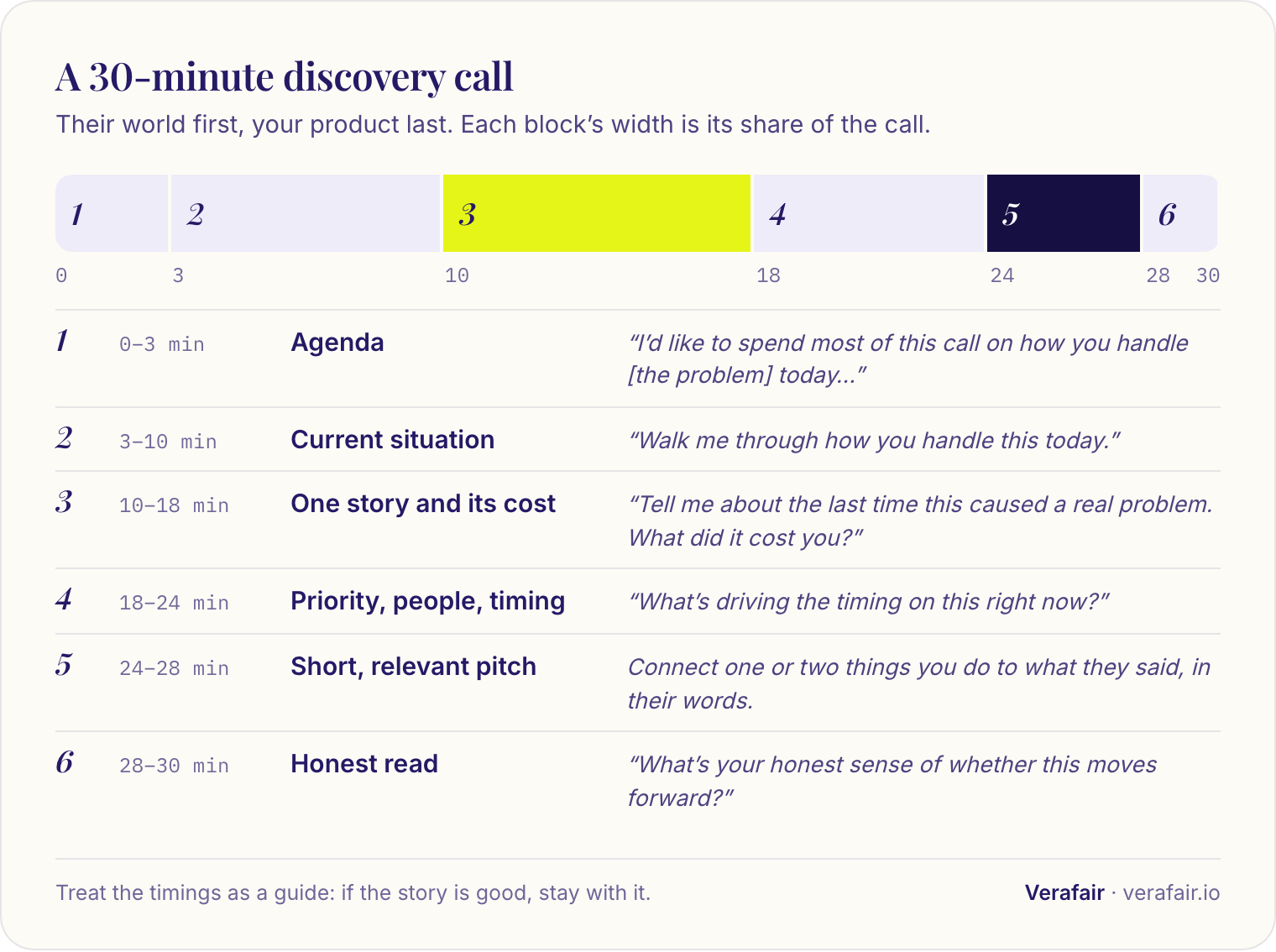
A sample discovery call script (30 minutes)
Treat the timings as a guide: if the story in minute 8 is good, stay with it.
| Time | Focus | Say something like |
|---|---|---|
| 0–3 min | Agenda | “I’d like to spend most of this call on how you handle [the problem] today, then share a bit about us if it looks relevant. Anything you want to cover?” |
| 3–10 min | Current situation | “Walk me through how you handle this today.” |
| 10–18 min | One story and its cost | “Tell me about the last time this caused a real problem. What did it cost you?” |
| 18–24 min | Priority, people, timing | “What’s driving the timing on this right now?” |
| 24–28 min | Short, relevant pitch | Connect one or two things you do to what they said, in their words. |
| 28–30 min | Honest read | “What’s your honest sense of whether this moves forward?” |
The Call Prep Template (PDF) turns your chosen questions into a one-page plan.
What should you do after a discovery call?
Write down what the prospect actually said, not what you concluded, and decide honestly whether there’s a deal.
- Note the evidence within the hour: the story, real numbers, people named, and the trigger behind the timing, in their words.
- Separate facts from hopes. “Our biggest client flagged it last month” is a fact; “Yeah, probably” is not a timeline.
- Send a short recap with the agreed next step, and ask them to correct anything you got wrong.
- Check how you asked. If a key answer followed a leading question, treat it as unconfirmed. The discovery call checklist and how to audit your own customer discovery calls cover this in more detail.
Check your own calls
Qualification checklists are easy to fill in with polite guesses. Run a sales discovery call transcript through Verafair to see which questions opened the prospect up, which ones felt like an interrogation, and the exact rewrite for each.
Frequently asked questions
What are good sales discovery questions? Good sales discovery questions ask what a prospect already does, has tried, and has spent, phrased as “tell me about” or “walk me through” rather than as a status check or a prediction. They get you a real story instead of a polite guess.
What is a discovery call in sales? A discovery call is the early sales conversation where you learn a prospect’s situation, problem, priorities, and buying process to decide whether there’s a real fit. It comes before any demo or proposal.
How do I qualify budget without directly asking “do you have budget”? Ask what they’re currently spending to deal with the problem, whether that’s a tool, a workaround, or people’s time. It gets you the same information without putting them on the spot.
Isn’t a discovery call supposed to be a checklist (BANT, MEDDIC, SPIN)? Frameworks tell you what to learn, not how to ask it. BANT (budget, authority, need, timeline) is covered by questions 8–17 above, MEDDIC’s pain, metrics, buyer and process by 4–5 and 11–14, and SPIN’s situation, problem and implication questions by 1–7 and 16, all without reading the framework out as a checklist.
How is a sales discovery call different from a product discovery call? The goal differs — one qualifies a deal, the other learns about needs — but the technique is the same: ask about what already happened, avoid leading questions, and don’t pitch until you’ve listened.
Related guides
- How to audit your own customer discovery calls
- Leading questions in customer interviews: 15 examples and better rewrites
- 30+ open-ended question examples (and how they differ from closed questions)
- Customer discovery questions: 30 open-ended questions to ask
- Follow-up questions cheat sheet: 20 ways to say “tell me more”
- Discovery call checklist: before, during and after