
To test a concept without selling it, show it before you explain it, ask what they understood, and ask separately what they liked and what worries them. Only after you've heard their unprimed reaction should you explain what you meant. This order stops your enthusiasm from becoming their opinion.
Concept testing is where people are most tempted to sell. You're excited, you've worked hard on the idea, and the person in front of you is being polite. It's very easy to leave with a pile of "I love it" and no real information.
The 5-step order
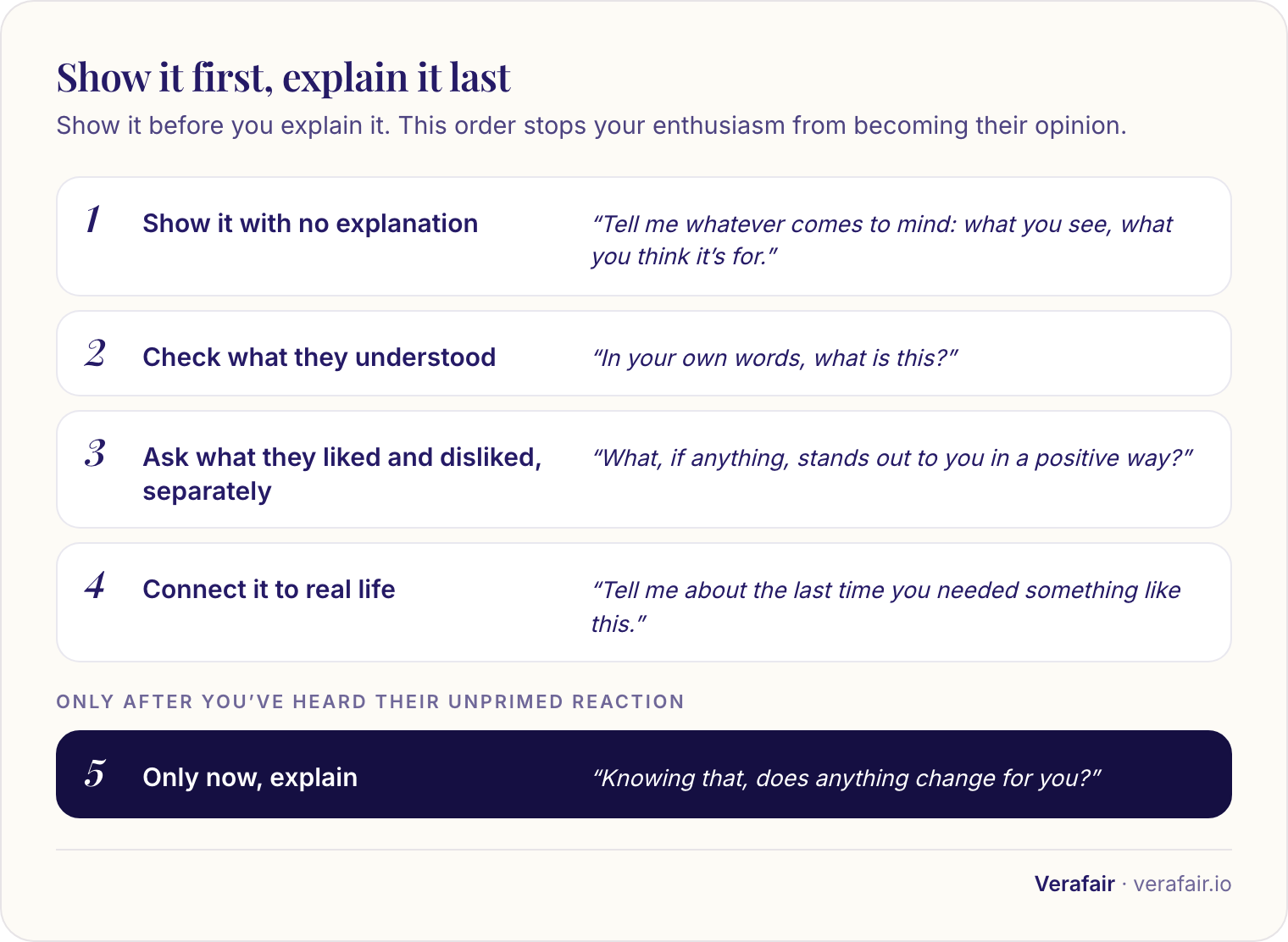
Step 1: Show it with no explanation
Put the concept in front of them (a sketch, a page, a one-paragraph description) and say only:
"I'm going to show you something. Take a moment and tell me whatever comes to mind: what you see, what you think it's for."
Then be quiet. Their first reaction is the most honest one you will get, and it's gone the moment you start explaining.
Step 2: Check what they understood
Ask:
- "In your own words, what is this?"
- "Who do you think it's for?"
- "What would you expect it to do?"
If they describe something different from what you intended, that is your most important finding. It's not their mistake. It means the concept isn't clear yet.
Step 3: Ask what they liked and disliked, separately
Don't ask "What do you think?" in one go. Split it in two:
- "What, if anything, stands out to you in a positive way?"
- "What, if anything, is confusing, or feels like it might not work for you?"
Splitting it gives permission to be critical. The word "if anything" keeps you from implying the answer.
Step 4: Connect it to real life
People say "That looks useful" about everything. Ground it:
- "Tell me about the last time you needed something like this. What did you do?"
- "Where would this have fit in that moment?"
- "What would have to be true for you to actually use it?"
If they can't name a real moment, the interest is probably polite, not real.
Step 5: Only now, explain
Once you have their first reaction, understanding, and reasons, explain what you intended. Then ask: "Knowing that, does anything change for you?"
What "selling" looks like (and what to say instead)
| You said | The problem | Try |
|---|---|---|
| "As you can see, this makes it much faster." | You told them the benefit | "What do you notice about it?" |
| "Do you like it?" | Invites a polite yes | "What stands out, if anything?" |
| "Everyone we've shown loves this part." | Sets a norm to agree with | "How does that part land for you?" |
| "It's meant to solve X, which I'm sure you've had." | Assumes the problem | "Does this connect to anything you deal with?" |
| "So would you buy it?" | A guess about the future | "What would you do next if this existed?" |
What to do when someone says "I love it"
Great, and now find out what's behind it:
- "Tell me more about what you like."
- "When would you use it?"
- "Tell me about the last time you needed something like this."
Enthusiasm with no story attached is worth very little. Enthusiasm with a specific story is worth a lot.
What to do when someone criticizes it
- Don't defend. "Thanks, that's really useful. Tell me more."
- Don't fix on the spot. Write it down and keep listening.
- Thank them. Criticism is a gift in concept testing.
Three habits that keep you honest
- Write down what would make you change your mind, before the session.
- Show every person the concept in the same way, in the same order.
- Keep a tally of what people said in their own words. If the only positive comments come after you explained it, treat it as a warning sign.
Check your own calls
It's hard to hear yourself selling. Paste your concept testing transcript into Verafair and select "Concept Testing." It checks whether you got an unprimed reaction before explaining, probed understanding and likes/dislikes separately, and avoided fishing for praise.
Frequently asked questions
What is concept testing? Concept testing is showing people an early idea (a sketch, description, or prototype) to learn whether they understand it and whether it fits their real life, before you build it.
Why not explain the idea first? Once you explain it, their reaction is shaped by your explanation. You lose the chance to see how it comes across on its own.
How do I get honest feedback when people are polite? Ask what confuses them or might not work, give explicit permission to criticize, and connect the concept to their real past experiences.
How many people should I test with? Enough to hear repeated patterns. If several people misunderstand the same part, you've found something real.
Is "would you use this?" ever okay? It's a weak question because people are poor at predicting their own behavior. Ask what they did last time, and what they'd do next, instead.